

Client
An established Saudi industrial products distributor supplying construction materials, industrial supplies, and maintenance products to contractors and industrial customers across the Kingdom through a traditional branch-and-sales-representative model. Facing margin compression, the entry of digitally native competitors, and changing customer purchasing behaviour, the distributor engaged Saudi Strategy Advisory to design and guide a transformation of its business model toward a digital B2B platform.
Issues
- Margin Erosion in a Traditional Model: The distributor's branch-and-representative model carried a high cost-to-serve and was generating declining margins as price transparency increased and customers consolidated purchasing. The existing model could not sustain the company's profitability targets.
- Digital Competitive Threat: Digitally native B2B competitors and manufacturer-direct channels were beginning to capture share by offering online ordering, transparent pricing, and faster fulfilment. The distributor risked structural decline if it did not respond with its own digital proposition.
- Fragmented Data & Systems: Customer, inventory, and pricing data were fragmented across legacy systems and branch-level processes, preventing the integrated visibility a platform model required and undermining the company's ability to manage pricing and service centrally.
- Organisational & Capability Gaps: The organisation was structured around physical branches and personal sales relationships and lacked the digital, e-commerce, and data capabilities required to operate a platform model, raising significant change-management and talent challenges.
- Channel Conflict Risk: A shift to digital channels risked alienating the sales force and disrupting valuable customer relationships if not carefully managed, creating internal resistance and potential short-term revenue disruption.
Solution
Saudi Strategy Advisory was engaged to design and guide a Business Model Transformation — providing the distributor with a target operating model for a digital B2B platform, a value-creation roadmap, an organisational and capability plan, and a phased implementation approach that managed channel conflict and protected core revenue during the transition.
Approach
- Customer & Economics Diagnostic: Analysed customer segments, purchasing behaviour, and the cost-to-serve and profitability of the existing model, quantifying the margin erosion drivers and the value at stake from both digital disruption and digital opportunity.
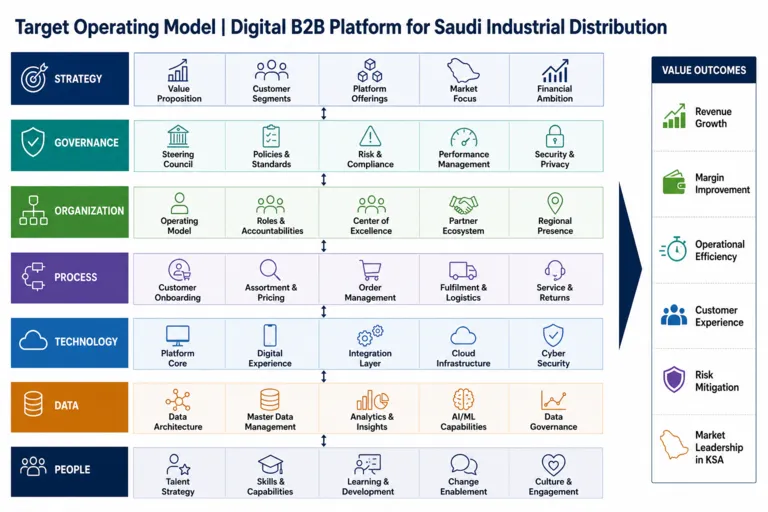
- Target Operating Model Design: Designed a target business model combining a digital B2B ordering platform, centralised pricing and inventory management, a tiered fulfilment network, and a redefined role for the sales force focused on high-value accounts and solution selling.
- Technology & Data Architecture: Defined the e-commerce platform, integration, and data architecture required to unify customer, inventory, and pricing data and to enable online ordering, dynamic pricing, and analytics, specifying a pragmatic build-and-integrate roadmap.
- Organisation & Capability Plan: Developed the organisational design, role definitions, capability-building programme, and talent acquisition plan required to operate the platform model, including a redefined incentive structure aligning the sales force with the new channel mix.
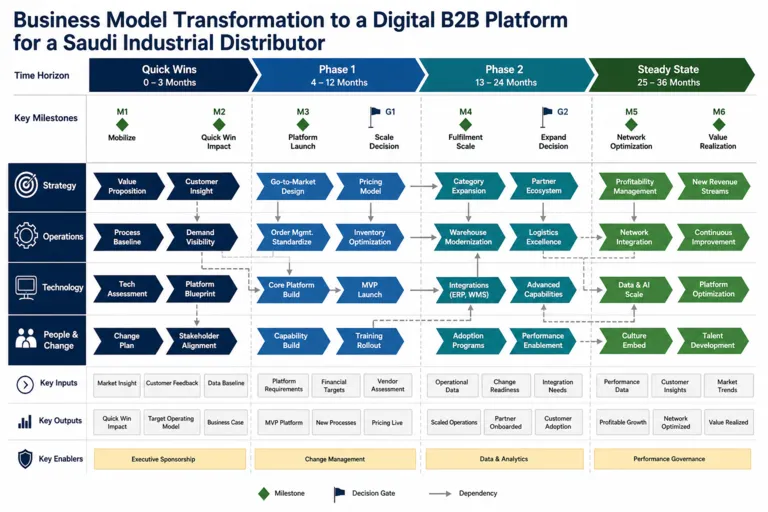
- Phased Transformation Roadmap: Built a phased implementation roadmap sequencing platform launch, customer migration, and operating-model change to manage channel conflict, protect core revenue, and demonstrate value at each stage to sustain organisational momentum.
Recommendations
- Sales-Force Augmentation, Not Replacement: Recommended repositioning the sales force as account managers and solution advisors layered on top of the digital platform rather than displacing them, converting potential resistance into advocacy and protecting key customer relationships during migration.
- Phased Customer Migration: Recommended migrating customers to the platform in waves, beginning with high-volume transactional accounts where digital ordering delivered the clearest mutual benefit, before extending to relationship-led accounts, reducing disruption and proving value incrementally.
- Centralised Pricing & Margin Management: Recommended centralising pricing and margin management on the new data platform, replacing inconsistent branch-level discretion with disciplined, analytics-driven pricing to recover margin while remaining competitive.
- Fulfilment Network Optimisation: Recommended rationalising the physical branch network into a tiered fulfilment model combining a smaller number of full-service hubs with leaner pickup and delivery points, reducing fixed cost while improving service speed.
Engagement ROI
- Margin Recovery: Centralised, analytics-driven pricing and a lower cost-to-serve were projected to improve gross margin by approximately 3.5 percentage points within two years, reversing the company's margin-erosion trajectory.
- Cost-to-Serve Reduction: The tiered fulfilment model and digital ordering reduced transactional servicing costs, with the redesigned network projected to lower operating cost-to-serve by an estimated SAR 60 million annually at scale.
- Revenue Defence & Growth: The digital platform enabled the distributor to defend share against digital entrants and to win new transactional accounts, with online channels projected to account for a substantial share of revenue within three years.
- Protected Customer Relationships: The sales-force augmentation approach preserved key accounts through the transition, avoiding the customer attrition that a poorly managed digital shift would have caused.
- Future-Ready Operating Model: The transformation positioned the distributor as a digitally enabled platform business, improving its competitive resilience and creating optionality for future value-added services and adjacent market expansion.
Talk to us for your needs in:
-
Economic & Social Impact Assessment
-
Environmental Impact Assessment & ESG
-
Market Entry Strategy
-
Business Model Transformation
-
Project Management Office (PMO)
-
Site Selection Advisory
-
Risk Assessment
-
Operational Excellence
-
Supply Chain Analysis
-
Feasibility Study
-
Growth Strategy
-
Mergers & Acquisitions (M&A)