

Client
A Saudi giga-project development authority responsible for delivering a large-scale tourism and entertainment destination on the Kingdom's coastline, conceived as a flagship contribution to Vision 2030's quality-of-life and economic diversification agenda. With a multi-phase capital programme exceeding SAR 30 billion and a mandate to demonstrate measurable national value beyond direct construction activity, the authority engaged Saudi Strategy Advisoryto quantify the destination's economic and social impact and to substantiate the development case to government stakeholders, co-investors, and the communities within the project's catchment area.
Issues
- Unsubstantiated Economic Value Claims: The authority's investment narrative relied on high-level economic contribution figures that had not been derived from a defensible, modelled assessment. Government stakeholders and prospective co-investors required an independent, evidence-based quantification of the destination's contribution to GDP, employment, and non-oil revenue before committing to the next funding phase.
- Employment & Saudization Impact: The development was expected to generate substantial direct and indirect employment, but the authority lacked a credible breakdown of job creation by phase, skill category, and Saudization potential. This limited its ability to align the project with national employment targets and to plan the workforce development interventions required to capture local employment benefit.
- Local Community & Social Effects: The destination's catchment included established local communities whose social fabric, cost of living, and access to services would be materially affected. The authority had not systematically assessed displacement risk, social cohesion effects, or the distribution of benefits and costs across affected population groups.
- Supply Chain & Local Content Leakage: A significant share of early procurement was flowing to international suppliers, raising the risk that economic value would leak outside the Kingdom. The authority needed to understand the realistic local content potential of its supply chain and the interventions required to maximise domestic value capture.
- Stakeholder & Governance Reporting: The authority was required to report impact outcomes against Vision 2030 programme metrics but had no measurement framework, baseline, or set of indicators against which progress could be tracked and communicated credibly to oversight bodies.
Solution
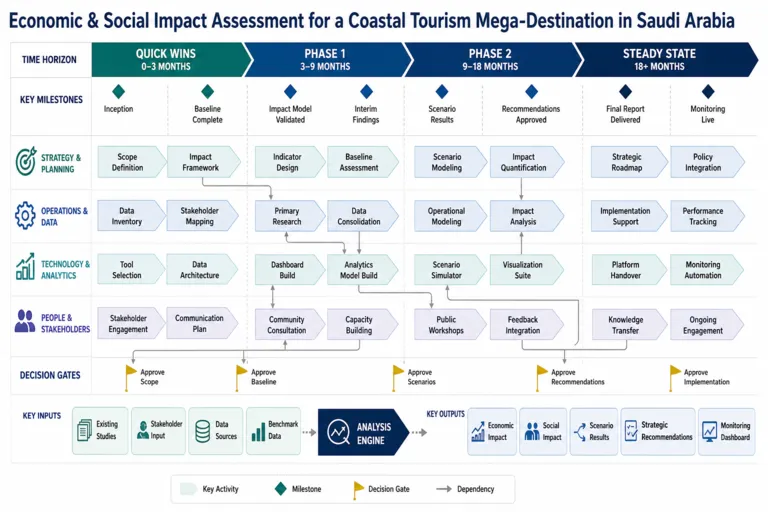
Saudi Strategy Advisory was engaged to deliver a comprehensive Economic & Social Impact Assessment — providing the authority with an independent, modelled quantification of the destination's economic contribution, employment effects, social impacts, and local content potential, together with a measurement framework enabling credible reporting against Vision 2030 objectives.
Approach
- Economic Impact Modelling: Built a multi-phase economic impact model using input-output and computable analysis techniques to quantify direct, indirect, and induced contributions to GDP, gross value added, non-oil revenue, and tax receipts across the construction and operational phases of the destination.
- Employment & Skills Analysis: Estimated direct and indirect job creation by phase, sector, and skill category, and assessed realistic Saudization potential for each role family against current labour market supply, identifying the skills gaps and workforce development interventions required to maximise national employment benefit.
- Social Impact Assessment: Conducted a structured social impact assessment across affected communities, evaluating effects on housing affordability, public services, social cohesion, cultural heritage, and vulnerable groups, and identifying mitigation and benefit-sharing measures aligned with international social safeguard standards.
- Local Content & Supply Chain Analysis: Mapped the project's procurement profile, benchmarked realistic local content potential by spend category, and identified the supplier development, localisation, and procurement policy interventions capable of increasing domestic value capture without compromising delivery timelines.
- Impact Measurement Framework: Developed a baseline and a set of economic and social indicators aligned with Vision 2030 programme metrics, enabling the authority to track, verify, and report impact outcomes to government oversight bodies throughout the development lifecycle.
Recommendations
- Phased Local Content Targets: Recommended adopting phased local content targets rising from current levels toward a credible long-term ceiling, supported by a supplier development programme and procurement policy adjustments. The trajectory was calibrated to be ambitious yet achievable given the maturity of the domestic supplier base.
- Workforce Development Partnership: Recommended establishing structured partnerships with technical and vocational training institutions to build the hospitality, operations, and technical skills pipeline required, prioritising the role families with the highest Saudization potential and the largest projected headcount.
- Community Benefit-Sharing Programme: Recommended a formal benefit-sharing programme for affected communities, including local employment guarantees, small-business participation mechanisms, and investment in community services, to convert social risk into demonstrable local support for the development.
- Independent Impact Reporting: Recommended annual independent reporting of economic and social outcomes against the agreed indicator set, strengthening the credibility of the authority's impact claims with government, co-investors, and the public.
Engagement ROI
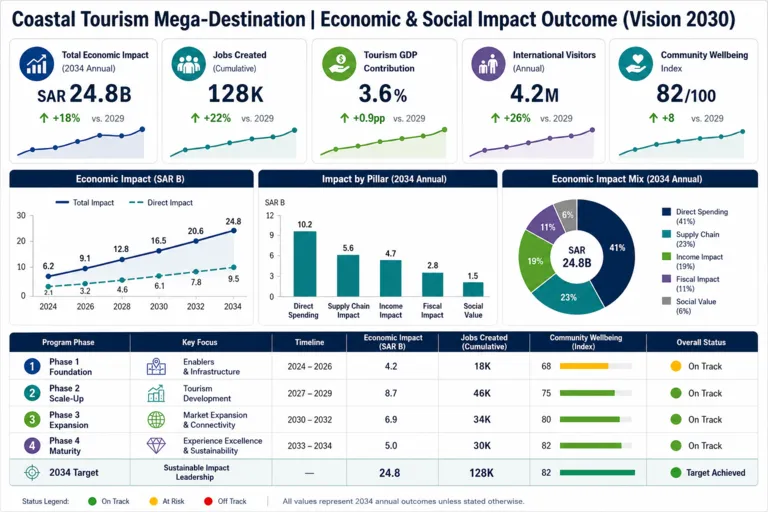
- Funding Case Substantiation: The modelled assessment provided the evidence base that supported approval of the destination's next capital funding phase, replacing contested high-level claims with a defensible quantification of national economic contribution.
- Local Value Capture: The local content roadmap identified interventions projected to retain an additional SAR 1.9 billion of procurement spend within the Kingdom over the construction phase, materially improving the project's domestic economic contribution.
- Employment Outcomes: The workforce development plan positioned the destination to fill a substantially higher share of operational roles with Saudi nationals than the sector baseline, directly supporting national employment targets and reducing long-term expatriate dependency.
- Social Licence to Operate: Early implementation of the community benefit-sharing programme reduced opposition risk among affected communities and strengthened the authority's social licence to proceed with subsequent development phases.
- Credible Vision 2030 Reporting: The measurement framework enabled the authority to report verifiable progress against Vision 2030 quality-of-life and diversification metrics, reinforcing its standing with national oversight bodies and securing continued programme support.
Talk to us for your needs in:
-
Economic & Social Impact Assessment
-
Environmental Impact Assessment & ESG
-
Market Entry Strategy
-
Business Model Transformation
-
Project Management Office (PMO)
-
Site Selection Advisory
-
Risk Assessment
-
Operational Excellence
-
Supply Chain Analysis
-
Feasibility Study
-
Growth Strategy
-
Mergers & Acquisitions (M&A)