

Client
Issues
The conglomerate faced a set of strategic, financial, and operational challenges at the intersection of its conventional industrial business model and Saudi Arabia's accelerating energy transition agenda:
- Decarbonization Strategy Gap: The group lacked a structured, board-approved decarbonization roadmap aligned with Saudi Arabia's net zero by 2060 commitment and the Saudi Green Initiative's sectoral emissions reduction targets. This created reputational risk with international partners, lender ESG requirements, and potential future regulatory exposure as Saudi Arabia's carbon governance framework matures.
- Green Hydrogen Opportunity Assessment: The group's leadership recognized the strategic significance of Saudi Arabia's green hydrogen ambitions but lacked the technical and financial analysis needed to determine whether direct investment in green hydrogen production represented a commercially viable and strategically aligned opportunity for the conglomerate's specific asset base and capability profile.
- Stranded Asset Risk: A significant portion of the group's industrial asset portfolio carried meaningful stranded asset risk as Saudi Arabia's energy transition accelerates, requiring a structured assessment of which assets should be optimized, repurposed, or divested as part of a credible transition strategy.
- ESG Reporting & Investor Communication: International joint venture partners and institutional lenders were increasingly requiring structured ESG reporting aligned with TCFD recommendations and GRI standards. The group had not yet developed this capability, creating friction in existing financing relationships and new capital-raising processes.
- Renewable Energy Integration: The group's industrial facilities had significant potential for on-site renewable energy integration that could materially reduce operating costs and Scope 1 emissions. However, the group lacked the technical assessment and financial modeling needed to prioritize and structure renewable energy investments across its facility portfolio.
Solution
Saudi Strategy Advisory was engaged to deliver an integrated energy transition strategy — combining decarbonization roadmap development, green hydrogen investment feasibility analysis, stranded asset risk assessment, renewable energy integration planning, and ESG reporting framework design — providing the conglomerate's board with a comprehensive, credible, and commercially grounded transition strategy.
Approach
The engagement was structured across five integrated analytical workstreams:
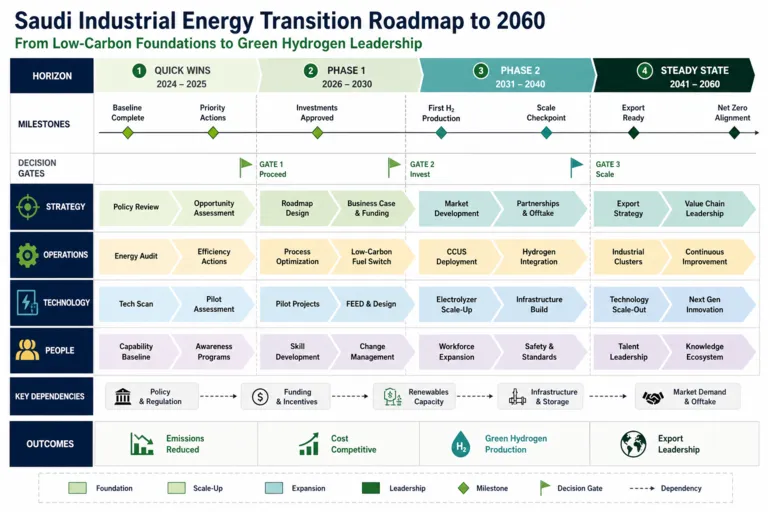
- Energy Transition Strategy & Decarbonization Roadmap: Conducted a comprehensive assessment of the group's current emissions profile across Scope 1, 2, and 3 emissions sources, benchmarked against Saudi sectoral peers and international best-practice decarbonization trajectories. Developed a structured decarbonization roadmap with phased emissions reduction targets, technology pathway options, capital investment requirements, and regulatory alignment milestones aligned with Saudi Arabia's net zero by 2060 commitment.
- Green Hydrogen Feasibility Study: Conducted a detailed feasibility assessment of green hydrogen production investment options, evaluating electrolyzer technology alternatives, renewable energy sourcing strategies, water availability constraints, logistics infrastructure requirements, offtake market opportunities, capital cost structures, operating expense models, and financial return scenarios under multiple pricing and policy support assumptions calibrated to Saudi Arabia's emerging hydrogen economy landscape.
- Stranded Asset Risk Assessment: Systematically evaluated the transition risk exposure of the group's conventional industrial asset portfolio, assessing each asset's remaining useful life, retrofit and repurposing potential, regulatory phase-out risk timeline, and residual value under multiple transition scenarios. Delivered a prioritized asset portfolio strategy distinguishing assets to optimize, transition, and divest.
- Renewable Energy Integration Planning: Assessed on-site renewable energy integration potential across the group's industrial facility portfolio, evaluating solar PV, concentrated solar power, and battery storage options against facility energy consumption profiles, grid connection conditions, available incentive frameworks, and financial return thresholds. Delivered a prioritized renewable energy investment roadmap supported by detailed financial modeling for the highest-priority opportunities.
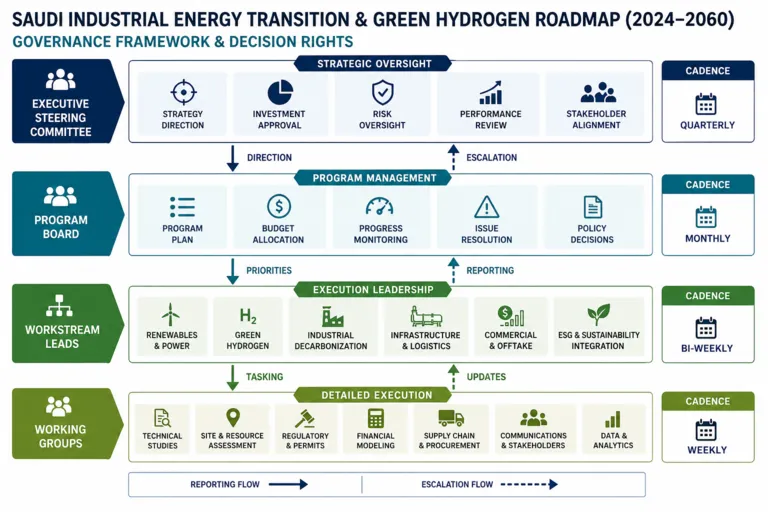
- ESG Framework & Reporting Design: Developed a comprehensive ESG reporting framework aligned with TCFD recommendations, GRI Standards, and Saudi Arabia's CMA sustainability disclosure guidelines, including materiality assessment, KPI definition, data collection system design, and board-level governance structures for ongoing ESG oversight.
Recommendations
Key strategic recommendations delivered through the engagement:
- Phased Decarbonization Roadmap: Recommended a three-horizon decarbonization strategy — Near-term (2024–2027) focused on energy efficiency and renewable integration; Medium-term (2027–2032) targeting fuel switching and process electrification; and Long-term (2032–2060) incorporating carbon capture and green hydrogen integration. The roadmap outlined a total estimated capital investment of SAR 2.1 billion, generating a projected net present value of SAR 890 million through combined cost savings, carbon credit generation, and premium pricing from ESG-aligned customers.
- Green Hydrogen Investment Strategy: Advised against immediate large-scale green hydrogen production investment due to current electrolyzer cost trajectories and offtake market immaturity. Instead, recommended a structured preparatory investment program, including renewable energy asset development, technical capability building, and strategic partnerships with established green hydrogen technology providers, positioning the group for scaled market entry as economics improve between 2028 and 2030.
- Asset Portfolio Rationalization: Recommended the divestiture of three conventional industrial assets identified as carrying material stranded asset risk within a seven-year horizon, releasing approximately SAR 450 million in capital for redeployment into transition-aligned investment opportunities.
- Renewable Energy Priority Investments: Identified five priority on-site solar PV projects with a combined capacity of 85MW, offering an average equity IRR of 14.2% under existing Saudi renewable energy incentive frameworks. These projects represented an immediate capital deployment opportunity with attractive financial returns and meaningful Scope 2 emissions reduction benefits.
Engagement ROI
The energy transition strategy and feasibility advisory delivered significant strategic and financial value:
- Investment Decision Clarity: The green hydrogen feasibility analysis prevented a premature large-scale capital commitment estimated at SAR 1.8 billion while positioning the group for optimally timed market entry as technology economics continue to improve.
- Renewable Energy Pipeline: The prioritized renewable energy investment roadmap identified SAR 340 million in near-term solar investments projected to generate annual operating cost savings of SAR 67 million and reduce Scope 2 emissions by approximately 180,000 tonnes of CO₂ per year.
- Financing Relationship Improvement: The ESG framework and TCFD-aligned reporting resolved lender ESG compliance concerns, securing the renewal of a SAR 1.2 billion revolving credit facility on improved pricing terms that reflected the group's enhanced sustainability governance credibility.
- Strategic Partnership: The green hydrogen preparatory strategy facilitated a strategic technology partnership with a leading international electrolyzer manufacturer, providing preferred access to next-generation technology and market development collaboration that positioned the group competitively within Saudi Arabia's emerging hydrogen economy.
- Board Governance Enhancement: Implementation of the ESG governance framework received positive recognition from three international joint venture partners that had previously identified sustainability governance deficiencies as a concern during annual partnership review meetings.
Talk to us for your needs in:
-
Economic & Social Impact Assessment
-
Environmental Impact Assessment & ESG
-
Market Entry Strategy
-
Business Model Transformation
-
Project Management Office (PMO)
-
Site Selection Advisory
-
Risk Assessment
-
Operational Excellence
-
Supply Chain Analysis
-
Feasibility Study
-
Growth Strategy
-
Mergers & Acquisitions (M&A)