

Client
A Saudi petrochemicals producer embarking on a multi-billion-riyal capital expansion programme to increase production capacity and broaden its product slate in support of the Kingdom's downstream value-creation objectives under Vision 2030. With a capital programme exceeding SAR 10 billion exposed to market, execution, regulatory, and operational uncertainties, the producer engaged Saudi Strategy Advisory to conduct an enterprise risk assessment of the programme and to strengthen its risk-management framework.
Issues
- Concentrated Capital Exposure: The expansion concentrated a very large capital commitment in a small number of major projects, creating significant exposure to cost overruns, schedule delays, and demand shifts that could materially affect the producer's financial position if poorly managed.
- Market & Commodity Volatility: Petrochemical margins were exposed to feedstock cost movements, global product price cycles, and demand volatility. The producer needed to understand how these market risks could affect the returns and viability of the expansion under a range of scenarios. • Execution & Contractor Risk: Delivering large, complex process facilities on time and on budget depended on contractor performance, supply chain reliability, and effective project controls. The producer required an objective assessment of execution risk across the programme. • Regulatory, Environmental & Safety Risk: The facilities were subject to stringent environmental, safety, and regulatory requirements. Non-compliance or a major safety event carried severe financial, operational, and reputational consequences that needed structured assessment and mitigation. • Fragmented Risk Management: Risk was managed inconsistently across projects and functions, without an enterprise-level view that aggregated and prioritised the programme's most material risks for leadership attention and capital-allocation decisions.
Solution
Saudi Strategy Advisory was engaged to deliver an Enterprise Risk Assessment — providing the producer with a structured identification, quantification, and prioritisation of the capital programme's material risks, scenario-based financial analysis, and a strengthened risk-management framework to protect programme value and support disciplined decision-making.
Approach
- Risk Identification & Taxonomy: Developed a comprehensive risk taxonomy spanning market, execution, operational, regulatory, environmental, safety, and financial domains, and identified the specific risks attaching to each major project and to the programme as a whole.
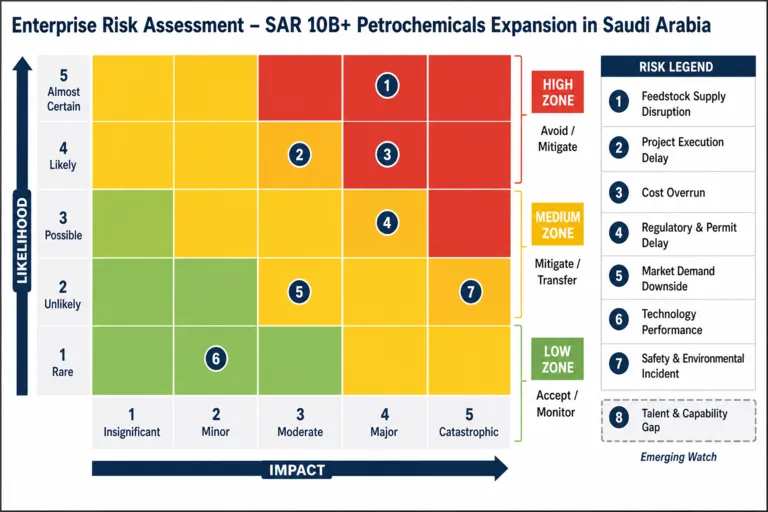
- Risk Quantification & Prioritisation: Assessed each material risk for likelihood and impact, quantifying financial exposure where possible, and prioritised the risks posing the greatest threat to programme value to focus leadership attention and mitigation resources.
- Scenario & Sensitivity Analysis: Modelled the financial performance of the expansion under a range of feedstock-cost, product-price, demand, and execution scenarios, identifying the conditions under which returns deteriorated and the risk factors to which value was most sensitive.
- Mitigation & Controls Design: Developed targeted mitigation strategies and control improvements for the highest-priority risks, covering commercial hedging, contracting strategy, project controls, compliance, and safety management, each with clear ownership and triggers.
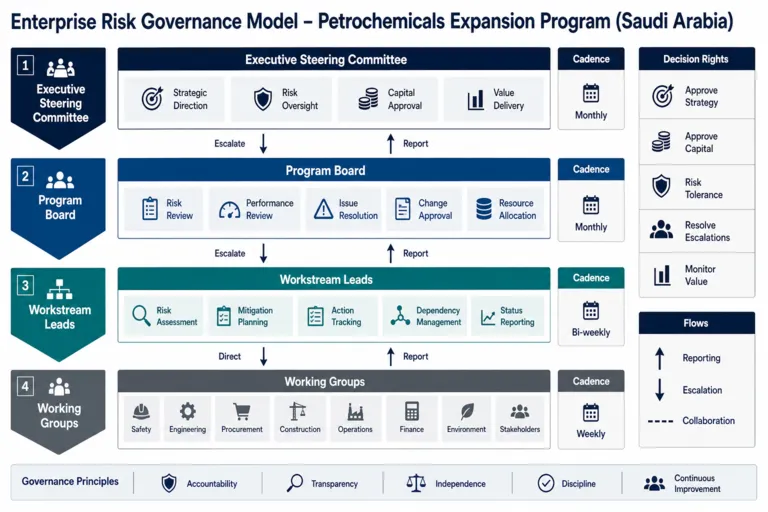
- Risk Governance Framework: Designed an enterprise risk-management framework providing aggregated risk reporting, defined risk appetite and escalation thresholds, and integration of risk assessment into capital-allocation and stage-gate decisions across the programme.
Recommendations
- Risk-Adjusted Stage Gates: Recommended embedding risk-adjusted criteria into the programme's stage-gate approvals, ensuring that capital was released to each project only when its key risks were within defined appetite and adequately mitigated.
- Commercial Hedging Strategy: Recommended a structured feedstock and product hedging strategy to reduce earnings volatility on the most price-sensitive product lines, protecting the financial returns underpinning the expansion case.
- Contracting & Contingency Strategy: Recommended a contracting strategy that allocated execution risk appropriately to capable contractors and established right-sized contingency reserves informed by the quantified execution-risk analysis rather than rule-of-thumb provisions.
- Integrated HSE & Compliance Assurance: Recommended strengthening integrated health, safety, environmental, and compliance assurance across the programme, recognising that a major incident represented the most severe single threat to programme value and the producer's licence to operate.
Engagement ROI
- Protected Capital: Embedding risk-adjusted stage gates and right-sized contingency strengthened capital discipline across the programme, reducing the likelihood of the unbudgeted cost growth that the quantified analysis showed could exceed SAR 600 million in adverse scenarios.
- Reduced Earnings Volatility: The hedging strategy was projected to materially dampen margin volatility on the most exposed product lines, improving the stability and predictability of programme returns for the producer and its stakeholders.
- Informed Investment Decisions: Scenario analysis gave leadership a clear view of the conditions under which the expansion remained value-accretive, enabling more confident and better-timed investment and sequencing decisions.
- Strengthened Risk Governance: The enterprise risk framework gave the board and executive team an aggregated, prioritised view of programme risk for the first time, improving oversight and the quality of capital-allocation decisions.
- Safeguarded Licence to Operate: Strengthened HSE and compliance assurance reduced the probability and potential severity of a major regulatory or safety event, protecting the producer's financial position, reputation, and licence to operate.
Talk to us for your needs in:
-
Economic & Social Impact Assessment
-
Environmental Impact Assessment & ESG
-
Market Entry Strategy
-
Business Model Transformation
-
Project Management Office (PMO)
-
Site Selection Advisory
-
Risk Assessment
-
Operational Excellence
-
Supply Chain Analysis
-
Feasibility Study
-
Growth Strategy
-
Mergers & Acquisitions (M&A)