

Client
A renewable energy developer preparing to construct a utility-scale solar photovoltaic plant in Saudi Arabia under the Kingdom's National Renewable Energy Programme, with generation capacity exceeding 1.5 gigawatts and a project value in excess of SAR 4 billion. Bidding into a competitive power purchase framework and seeking international project finance, the developer engaged Saudi Strategy Advisory to deliver a bankable environmental impact assessment and an ESG framework capable of satisfying both Saudi regulatory requirements and the environmental and social standards of international lenders.
Issues
- Regulatory Permitting Complexity: The project required environmental clearance under Saudi Arabia's environmental regulatory framework, involving multiple authorities and technical standards. The developer lacked clarity on the precise assessment scope, baseline studies, and documentation required to secure permitting without timeline-threatening delays.
- Lender ESG Standards Compliance: International project finance was contingent on compliance with lender environmental and social performance standards, which exceeded local regulatory requirements in several areas. The developer had no structured framework for demonstrating alignment with these standards across the project lifecycle.
- Land, Biodiversity & Water Sensitivities: The proposed site occupied a large desert footprint with potential effects on protected species, ecological corridors, and scarce groundwater resources. These sensitivities required rigorous baseline assessment and credible mitigation planning to avoid environmental objections and reputational exposure.
- Community & Land-Use Effects: The site interacted with traditional land uses and nearby settlements. The developer required an assessment of social effects, land-access arrangements, and community engagement obligations to manage social risk and meet lender social safeguard requirements.
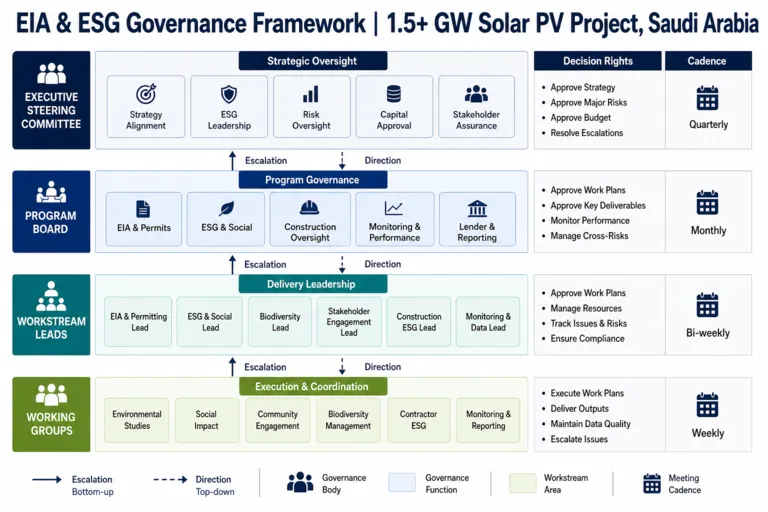
- ESG Governance & Monitoring: Beyond permitting, the developer needed an embedded ESG governance structure and a monitoring and reporting system capable of evidencing ongoing performance to regulators, lenders, and the offtaker throughout construction and operations.
Solution
Saudi Strategy Advisory was engaged to deliver an integrated Environmental Impact Assessment and ESG Framework — providing the developer with a regulator-compliant and lender-bankable environmental assessment, robust mitigation planning, and an embedded ESG governance and monitoring system aligned with both Saudi requirements and international finance standards.
Approach
- Environmental Baseline & Impact Assessment: Conducted comprehensive baseline studies covering biodiversity, ecology, hydrology, air quality, noise, and cultural heritage, and assessed construction and operational impacts against Saudi regulatory thresholds and international performance standards to produce a permitting-ready environmental impact assessment.
- Lender ESG Gap Analysis: Assessed the project against the environmental and social performance standards applied by prospective international lenders, identified the specific gaps relative to local regulatory compliance, and defined the management plans and documentation required to close them.
- Mitigation & Management Planning: Developed a hierarchy of avoidance, minimisation, and offset measures for the most material environmental risks, including biodiversity action planning, water management protocols, and waste and decommissioning strategies, each translated into actionable construction-phase commitments.
- Social Assessment & Stakeholder Engagement: Assessed social effects on local land users and settlements, designed a stakeholder engagement and grievance mechanism meeting lender requirements, and structured land-access arrangements to reduce social and reputational risk.
- ESG Governance & Monitoring System: Designed an ESG governance structure with defined roles, performance indicators, and a monitoring and reporting system enabling the developer to evidence ongoing environmental and social performance to regulators, lenders, and the offtaker throughout the asset lifecycle.
Recommendations
- Integrated Permitting & Finance Track: Recommended running environmental permitting and lender ESG due diligence as a single integrated workstream, using one consolidated evidence base to satisfy both, reducing duplication and protecting the project's critical-path schedule.
- Biodiversity Net-Gain Approach: Recommended adopting a biodiversity action plan targeting net positive outcomes through habitat protection and offset commitments, positioning the project ahead of evolving regulatory expectations and strengthening its standing with lenders.
- Water-Efficient Operations Design: Recommended specifying waterless or low-water panel-cleaning technology and closed-loop water management, materially reducing groundwater dependency in a water-scarce setting and lowering long-term operational and reputational risk. • Embedded ESG Reporting: Recommended embedding the ESG monitoring system into project management from construction mobilisation, ensuring performance data was captured from day one and available for the periodic reporting required under the finance and offtake agreements.
Engagement ROI
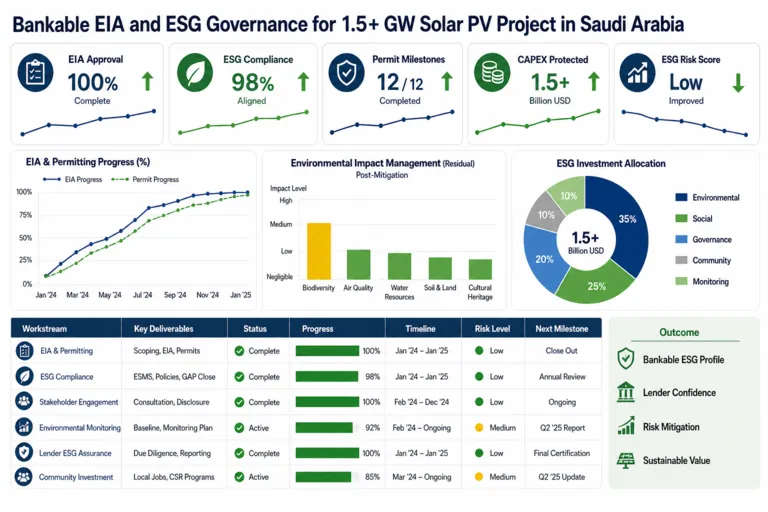
- Permitting Secured on Schedule: The integrated assessment enabled the developer to secure environmental clearance within the targeted permitting window, protecting the project's bid timeline and avoiding costly schedule slippage.
- Project Finance Unlocked: The lender-aligned ESG framework satisfied the environmental and social conditions of international financiers, supporting financial close on a debt package of approximately SAR 3 billion.
- Risk-Adjusted Cost Avoidance: Early identification and mitigation of biodiversity and water sensitivities avoided design changes and remediation costs estimated at SAR 70 million that would have arisen had these risks surfaced during construction.
- Reputational Protection: The stakeholder engagement and grievance mechanism reduced the risk of community objections and project delay, protecting the developer's reputation and its standing in subsequent renewable energy tenders.
- Repeatable ESG Platform: The ESG governance system was designed as a repeatable platform that the developer subsequently applied across its wider renewable energy pipeline, reducing the cost and time of ESG compliance on future projects.
Talk to us for your needs in:
-
Economic & Social Impact Assessment
-
Environmental Impact Assessment & ESG
-
Market Entry Strategy
-
Business Model Transformation
-
Project Management Office (PMO)
-
Site Selection Advisory
-
Risk Assessment
-
Operational Excellence
-
Supply Chain Analysis
-
Feasibility Study
-
Growth Strategy
-
Mergers & Acquisitions (M&A)