

Client
Issues
The healthcare network faced a complex set of interconnected operational, financial, and institutional challenges that needed to be resolved before privatization could credibly proceed:
- Operational Inefficiency: Significant inefficiencies in patient flow management, bed utilization, clinical staff scheduling, and supply chain procurement were driving operating costs materially above regional benchmarks while simultaneously degrading patient experience and clinical outcome performance.
- Financial Sustainability Gap: The network's cost structure, revenue cycle management, and capital allocation frameworks were not configured for a commercially sustainable operating model. Significant revenue leakage in billing processes, overstocked pharmaceutical inventories generating unnecessary carrying costs, and deferred maintenance were creating escalating capital expenditure requirements.
- Governance & Accountability Deficits: Weak performance management frameworks, unclear accountability structures, and inadequate management information systems meant the network's leadership lacked the real-time operational and financial visibility needed to manage performance proactively or demonstrate institutional governance quality to potential private sector operators.
- Workforce & Saudization Challenges: An imbalanced workforce, with high dependency on expatriate clinical and administrative staff, created both Saudization compliance risk and workforce continuity vulnerability that potential privatization partners identified as a significant operational concern.
- Privatization Readiness Gap: The network had not yet developed the commercial operating frameworks, independent governance structures, financial reporting standards, or strategic positioning narratives needed to attract and satisfy the due diligence requirements of qualified private sector healthcare operators with the capabilities and capital to execute a successful privatization partnership.
Solution
Saudi Strategy Advisory was engaged to deliver an integrated healthcare transformation and privatization readiness advisory program — simultaneously improving the network's operational and financial performance, strengthening its governance framework, and developing the commercial positioning and transaction materials needed to attract qualified privatization partners.
Approach
The engagement was executed across four integrated workstreams over an 18-month program:
- Operational Performance Diagnostic & Improvement: Conducted a comprehensive operational assessment across all network facilities, mapping patient flow processes, clinical staffing models, bed management systems, supply chain operations, and facilities management frameworks against regional and international healthcare benchmarks. Designed and supported the implementation of targeted operational improvement initiatives prioritized by impact and implementation feasibility.
- Financial Transformation & Revenue Cycle Optimization: Analyzed the network's complete revenue cycle, from patient registration and clinical coding through insurance claim submission and collection, identifying revenue leakage points and implementing systematic improvements. Restructured pharmaceutical procurement and inventory management, rationalized operating cost structures, and developed a forward-looking financial model demonstrating the network's commercial sustainability trajectory under a privatized operating model.
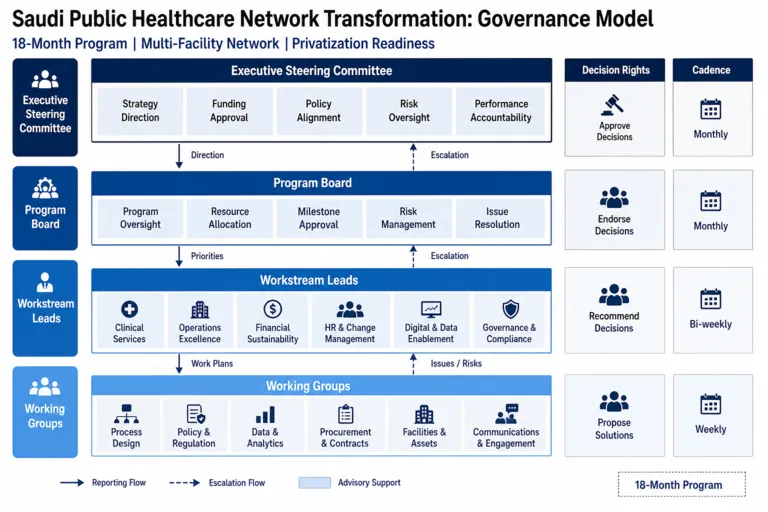
- Governance & Performance Management Framework: Designed and implemented a comprehensive governance framework, including board-level oversight structures, executive performance management systems, clinical quality dashboards, financial reporting frameworks, and operational KPI monitoring mechanisms. This strengthened institutional governance quality and transparency required by privatization partners and Ministry of Health oversight bodies.
- Privatization Readiness & Transaction Support: Developed the complete suite of privatization transaction materials, including an information memorandum, commercial operating model design, partnership structure options, due diligence data room preparation, and strategic positioning narrative. Supported the Ministry of Health and network leadership throughout the privatization partner identification and selection process.
Recommendations
The engagement was executed across four integrated workstreams over an 18-month program:
- Operational Performance Diagnostic & Improvement: Conducted a comprehensive operational assessment across all network facilities, mapping patient flow processes, clinical staffing models, bed management systems, supply chain operations, and facilities management frameworks against regional and international healthcare benchmarks. Designed and supported the implementation of targeted operational improvement initiatives prioritized by impact and implementation feasibility.
- Financial Transformation & Revenue Cycle Optimization: Analyzed the network's complete revenue cycle, from patient registration and clinical coding through insurance claim submission and collection, identifying revenue leakage points and implementing systematic improvements. Restructured pharmaceutical procurement and inventory management, rationalized operating cost structures, and developed a forward-looking financial model demonstrating the network's commercial sustainability trajectory under a privatized operating model.
- Governance & Performance Management Framework: Designed and implemented a comprehensive governance framework, including board-level oversight structures, executive performance management systems, clinical quality dashboards, financial reporting frameworks, and operational KPI monitoring mechanisms. This strengthened institutional governance quality and transparency required by privatization partners and Ministry of Health oversight bodies.
- Privatization Readiness & Transaction Support: Developed the complete suite of privatization transaction materials, including an information memorandum, commercial operating model design, partnership structure options, due diligence data room preparation, and strategic positioning narrative. Supported the Ministry of Health and network leadership throughout the privatization partner identification and selection process.
Engagement ROI
The transformation and privatization readiness program delivered significant measurable value:
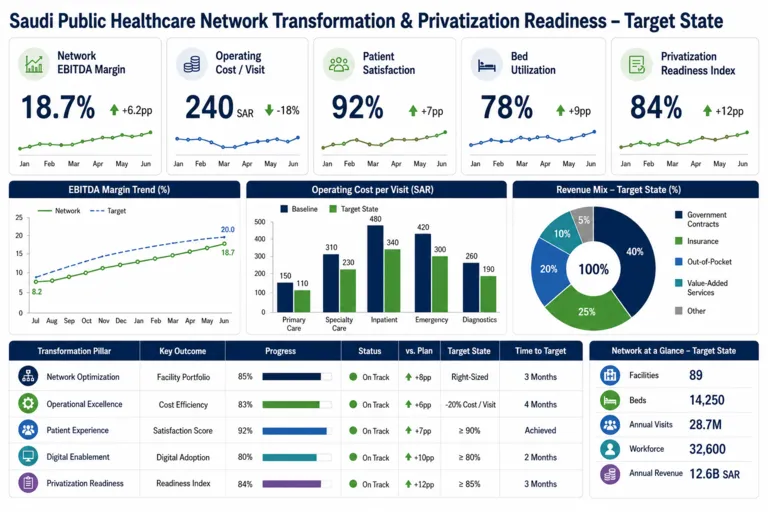
- Operational Cost Reduction: Implemented operational improvements generated annual cost savings of approximately SAR 78 million within 12 months of implementation.
- Revenue Recovery: Revenue cycle optimization recovered SAR 38 million in previously uncollected claims during the first year, with a projected additional SAR 45 million in annual improvements upon full program implementation.
- Privatization Transaction Success: The network successfully attracted three qualified private sector operator bids, completing privatization partner selection within eight months of transaction materials completion, four months ahead of the Ministry of Health's original program timeline.
- Clinical Performance Improvement: Patient satisfaction scores improved by 34%, while average length of stay decreased by 1.8 days across the network during the transformation program period.
- Governance Recognition: The network's restructured governance framework was recognized by the Saudi Central Board for Accreditation of Healthcare Institutions (CBAHI) as a model for public sector healthcare governance transformation within the Vision 2030 privatization program.
Talk to us for your needs in:
-
Economic & Social Impact Assessment
-
Environmental Impact Assessment & ESG
-
Market Entry Strategy
-
Business Model Transformation
-
Project Management Office (PMO)
-
Site Selection Advisory
-
Risk Assessment
-
Operational Excellence
-
Supply Chain Analysis
-
Feasibility Study
-
Growth Strategy
-
Mergers & Acquisitions (M&A)