

Client
Issues
The entity faced a complex set of strategic, operational, and investment challenges in developing a credible national cold chain infrastructure program:
- Infrastructure Gap Assessment: The Kingdom's cold chain infrastructure was fragmented, geographically concentrated, and technically inadequate. However, the entity lacked a comprehensive, data-driven assessment of specific capacity gaps, geographic coverage deficiencies, and technical standard shortfalls that a national cold chain development program needed to address.
- Investment Prioritization: With limited capital resources relative to the scale of infrastructure requirements, the entity required a rigorous investment prioritization framework to sequence cold chain infrastructure investments for maximum food security impact and commercial return. This required balancing national strategic priorities with the financial sustainability requirements of a commercially viable infrastructure program.
- Private Sector Partnership Structuring: The entity recognized that government capital alone would be insufficient to fund the full scale of required cold chain infrastructure investment and that private sector cold chain operators would need to be engaged as development and operational partners. However, it lacked the partnership structuring frameworks and commercial models needed to attract qualified private sector participants while preserving public interest objectives.
- Regulatory & Standards Framework: Saudi Arabia's cold chain sector operated under fragmented regulatory oversight involving multiple government bodies, including the Saudi Food and Drug Authority, the Ministry of Environment, Water and Agriculture, and municipal authorities. This created compliance complexity and investment uncertainty that discouraged private sector investment in cold chain infrastructure.
- Pharmaceutical Cold Chain Integration: The entity's mandate extended to pharmaceutical cold chain infrastructure, a technically distinct and highly regulated segment where Saudi Arabia's domestic distribution capacity was under significant strain. This required specialized technical assessment and regulatory navigation capabilities beyond the entity's internal expertise.
Solution
Saudi Strategy Advisory was engaged to develop a comprehensive National Cold Chain Infrastructure Strategy and Investment Plan — providing the entity with the demand analysis, infrastructure gap assessment, investment prioritization framework, private sector partnership models, and regulatory recommendations needed to launch a credible, commercially sustainable national cold chain development program.
Approach
The engagement was executed across four integrated workstreams:
- Demand Assessment & Infrastructure Gap Analysis: Conducted a comprehensive analysis of Saudi Arabia's cold chain demand across food commodities, processed food products, fresh produce, dairy, meat, seafood, and pharmaceutical products. Mapped existing cold chain capacity against demand by region, product category, and supply chain node to quantify infrastructure gaps with the level of specificity required to support investment prioritization decisions.
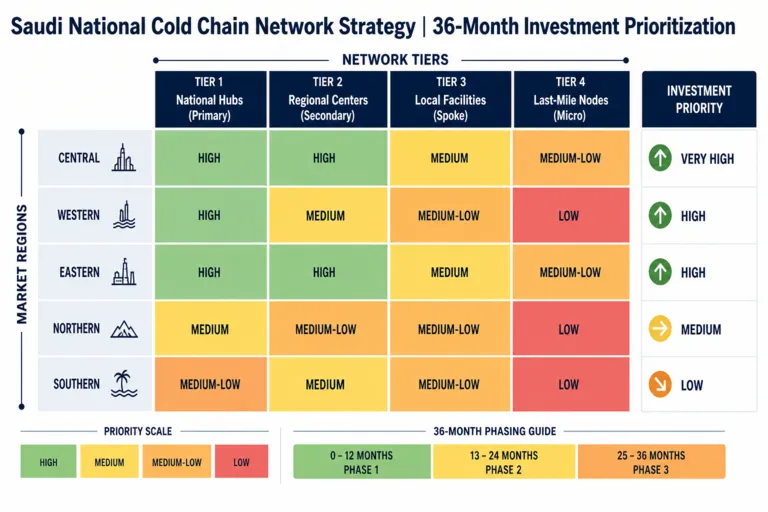
- Infrastructure Investment Prioritization: Developed a multi-criteria investment prioritization framework incorporating food security impact, commercial return potential, geographic coverage improvement, private sector development catalyst effects, and implementation feasibility. Applied the framework to a longlist of more than 40 potential cold chain infrastructure investment locations, resulting in a prioritized program of 12 high-priority development opportunities.
- Private Sector Partnership Model Design: Designed multiple public-private partnership models, ranging from anchor tenant agreements and build-operate-transfer structures to joint venture development platforms and regulated tariff frameworks. Evaluated each model against commercial attractiveness for private operators, public interest protection, government capital efficiency, and regulatory compliance feasibility within Saudi Arabia's infrastructure investment framework.
- Regulatory Framework Advisory: Assessed Saudi Arabia's existing cold chain regulatory landscape, identified the specific regulatory gaps and overlaps creating investment uncertainty, and developed structured recommendations for a harmonized national cold chain regulatory framework. The recommendations aimed to reduce compliance complexity, establish clear technical standards, and create the regulatory certainty needed to attract sustained private sector cold chain investment.
Recommendations
Key strategic recommendations delivered through the engagement:
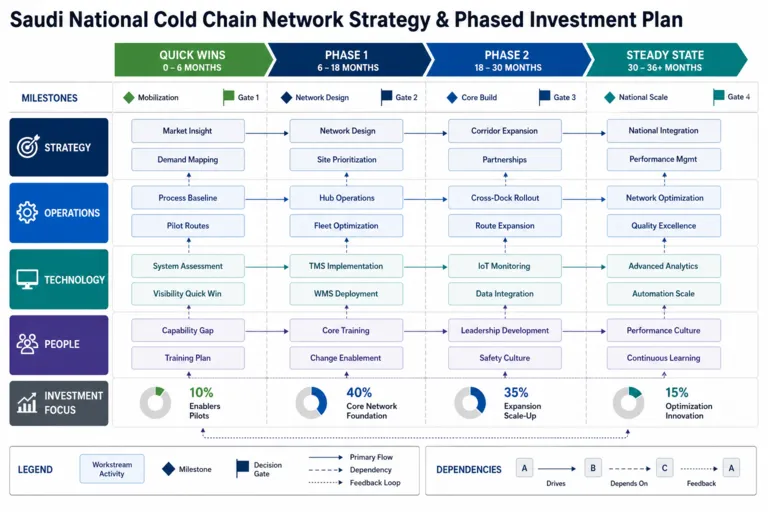
- National Cold Chain Network Architecture: Recommended a three-tier national cold chain network comprising four regional distribution hubs at strategic logistics nodes, twelve sub-regional consolidation centers, and twenty-eight urban last-mile cold storage facilities. The network was designed to provide comprehensive geographic coverage across Saudi Arabia's major population centers and food production zones while maintaining a commercially viable infrastructure utilization model.
- Investment Sequencing: Recommended prioritizing three regional hub developments in the first phase at locations offering the highest combination of food security impact, commercial demand, and private sector interest. The proposed first phase required an estimated capital investment of SAR 1.4 billion and a projected development timeline of 36 months.
- Anchor Tenant Partnership Model: Recommended adopting an anchor tenant agreement model for regional hub developments, securing long-term capacity commitments from major food retailers and food service operators before construction commencement. This approach reduced investment risk, improved project bankability, and accelerated private sector co-investment attraction.
- Pharmaceutical Cold Chain Track: Recommended establishing a dedicated pharmaceutical cold chain development program, separate from but integrated with the food cold chain network. The program would include specialized GDP (Good Distribution Practice)-compliant facility standards, a distinct regulatory framework, and targeted partnership models involving international pharmaceutical logistics specialists.
- Regulatory Harmonization: Recommended the creation of a National Cold Chain Standards Authority with consolidated regulatory oversight, eliminating existing multi-agency compliance complexity and providing a single-window regulatory interface to strengthen private sector investment confidence in Saudi Arabia's cold chain sector.
Engagement ROI
The National Cold Chain Infrastructure Strategy delivered significant strategic and investment value:
- Investment Program Launch: The prioritized investment program provided the entity with the analytical foundation needed to launch its first-phase cold chain development tender within six months of strategy completion, accelerating implementation by nine months compared to the original program timeline.
- Private Sector Interest: The partnership model design attracted expressions of interest from seven qualified private sector cold chain operators for Phase 1 hub development partnerships within three months of launching market engagement activities.
- Capital Efficiency: The investment prioritization framework concentrated available government capital on the three developments offering the highest combined food security impact and commercial return, delivering an estimated 2.3 times greater food security impact than the entity's original undifferentiated investment approach for the same level of capital expenditure.
- Food Loss Reduction: Full program implementation was projected to reduce Saudi Arabia's post-harvest food losses by approximately 340,000 tonnes annually, representing an estimated SAR 2.8 billion reduction in annual food supply chain waste while supporting national food security and sustainability objectives.
- Pharmaceutical Impact: The pharmaceutical cold chain recommendations provided the foundation for a separate SAR 480 million pharmaceutical logistics infrastructure program that subsequently attracted participation from international pharmaceutical logistics operators.
Talk to us for your needs in:
-
Economic & Social Impact Assessment
-
Environmental Impact Assessment & ESG
-
Market Entry Strategy
-
Business Model Transformation
-
Project Management Office (PMO)
-
Site Selection Advisory
-
Risk Assessment
-
Operational Excellence
-
Supply Chain Analysis
-
Feasibility Study
-
Growth Strategy
-
Mergers & Acquisitions (M&A)