

Client
A Saudi third-party logistics operator running a national network of warehouses and a road transport fleet serving retail, industrial, and e-commerce customers, positioned to benefit from the Kingdom's ambition to become a regional logistics hub under Vision 2030. Facing rising cost-to-serve, inconsistent service levels, and margin pressure as customers demanded faster and more reliable fulfilment, the operator engaged Saudi Strategy Advisory to drive a step-change in operational performance.
Issues
- Rising Cost-to-Serve: Warehouse and transport operating costs were rising faster than revenue, compressing margins. The operator lacked a granular understanding of cost drivers by site, activity, and customer, and could not target improvement effectively.
- Inconsistent Service Levels: Order accuracy, on-time delivery, and fulfilment speed varied significantly between sites and customers, generating complaints and putting key contracts at risk in an increasingly competitive market.
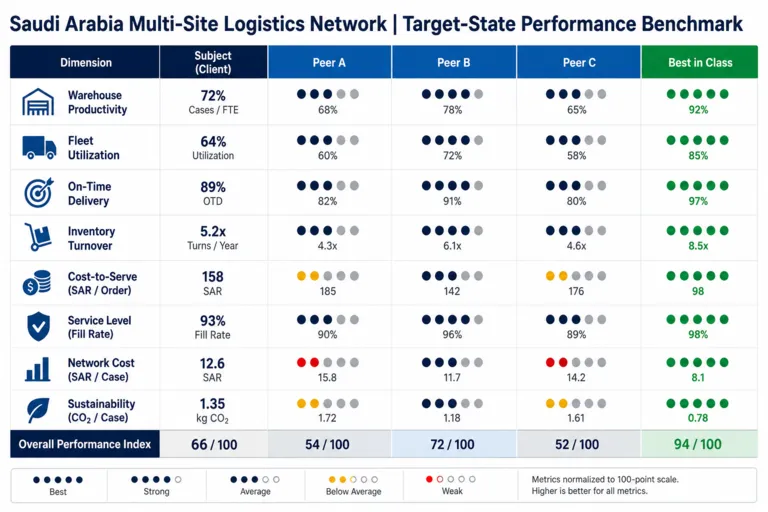
- Low Asset & Labour Productivity: Warehouse throughput per labour hour and fleet utilisation lagged benchmark performance, indicating significant productivity improvement potential that the operator had not systematically captured.
- Limited Performance Visibility: The operator lacked consistent operational KPIs, performance management routines, and data visibility across its network, preventing it from identifying underperformance and managing operations proactively.
- Saudization & Workforce Constraints: Reliance on expatriate operational labour created Saudization compliance risk and workforce-cost exposure, requiring a workforce strategy that improved productivity while building a sustainable local talent base.
Solution
Saudi Strategy Advisory was engaged to deliver an Operations Performance Improvement programme — providing the operator with a cost and performance diagnostic, redesigned warehouse and transport operations, a performance-management system, and a workforce plan to reduce cost-to-serve, lift service levels, and build sustainable operational capability.
Approach
- Operations Diagnostic & Benchmarking: Conducted a network-wide diagnostic analysing cost-to-serve by site, activity, and customer, and benchmarking warehouse throughput, fleet utilisation, and service performance against industry standards to quantify the improvement opportunity.
- Warehouse Process Redesign: Redesigned warehouse layouts, slotting, picking processes, and labour deployment at priority sites to lift throughput and accuracy, applying lean operating principles and standardised best practice across the network.
- Transport & Network Optimisation: Optimised route planning, load consolidation, fleet scheduling, and the balance between owned and subcontracted capacity to improve fleet utilisation and reduce transport cost per unit delivered.
- Performance Management System: Designed and implemented a consistent set of operational KPIs, dashboards, and performance-management routines across the network, giving site managers and leadership the visibility and cadence to manage operations proactively.
- Workforce & Saudization Plan: Developed a workforce plan combining productivity-led headcount optimisation, structured training, and a Saudization pathway, building a more productive and compliant operational workforce over time.
Recommendations
- Standardised Operating Model: Recommended rolling out a standardised warehouse and transport operating model across the network, replacing site-by-site variation with consistent best practice to lift the performance of lagging sites toward that of the best.
- Activity-Based Costing & Pricing: Recommended adopting activity-based costing to understand true cost-to-serve by customer and to renegotiate or reprice loss-making accounts, restoring profitability on underperforming contracts.
- Dynamic Transport Capacity: Recommended a flexible capacity model combining a core owned fleet with managed subcontractor capacity, enabling the operator to match capacity to demand peaks while reducing fixed fleet cost.
- Frontline Performance Management: Recommended embedding daily and weekly performance-management routines at site level, with clear KPIs and accountability, to sustain improvements and surface issues before they affected customers.
Engagement ROI
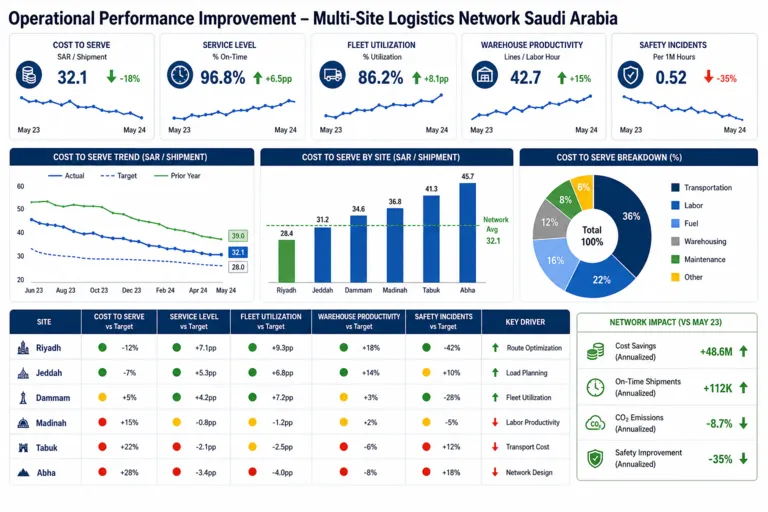
- Cost-to-Serve Reduction: The warehouse and transport improvements were projected to reduce overall operating cost-to-serve by approximately 14% within twelve months, materially improving margins across the network.
- Service Level Improvement: Process standardisation lifted on-time, in-full delivery performance at priority sites from the low-80s to above 95%, reducing complaints and strengthening the operator's position in contract renewals.
- Productivity Gains: Warehouse throughput per labour hour and fleet utilisation improved toward benchmark levels, unlocking capacity that allowed the operator to absorb volume growth without proportionate cost increases.
- Contract Profitability Restored: Activity-based costing enabled repricing of loss-making accounts, converting several previously unprofitable contracts to acceptable margins and improving overall portfolio profitability.
- Sustainable Capability: The performance-management system and workforce plan left the operator with the visibility, routines, and local talent base required to sustain improved performance and support continued growth as a regional logistics player.
Talk to us for your needs in:
-
Economic & Social Impact Assessment
-
Environmental Impact Assessment & ESG
-
Market Entry Strategy
-
Business Model Transformation
-
Project Management Office (PMO)
-
Site Selection Advisory
-
Risk Assessment
-
Operational Excellence
-
Supply Chain Analysis
-
Feasibility Study
-
Growth Strategy
-
Mergers & Acquisitions (M&A)