

Client
A Saudi healthcare development organisation responsible for delivering a multi-asset hospital construction programme comprising several new hospitals and specialist facilities across multiple regions, with a combined capital value exceeding SAR 6 billion and aligned with Vision 2030's Health Sector Transformation Program. Facing schedule slippage, cost overruns, and fragmented oversight across its delivery partners, the organisation engaged Saudi Strategy Advisory to establish a programme management office capable of restoring control and delivery certainty.
Issues
- Fragmented Programme Oversight: The programme was being delivered through multiple contractors, consultants, and internal teams with no unified governance, reporting, or control framework. Leadership lacked a single, reliable view of programme status, cost, and risk across the asset portfolio.
- Schedule Slippage & Cost Overruns: Several assets were experiencing schedule delays and budget overruns that were being identified too late for effective intervention, threatening the programme's overall delivery timeline and budget envelope.
- Inconsistent Controls & Reporting: Cost, schedule, risk, and change-control processes varied between assets and partners, producing inconsistent and non-comparable reporting that prevented leadership from prioritising attention and resources effectively.
- Weak Risk & Interface Management: Interdependencies and interfaces between design, construction, equipment procurement, and commissioning were poorly managed, generating clashes, rework, and delay that a coordinated programme function could have prevented.
- Limited Decision Support: Leadership lacked the structured data, forecasting, and escalation mechanisms required to make timely, well-informed decisions on issues affecting cost, schedule, and clinical readiness across the programme.
Solution
Saudi Strategy Advisory was engaged to establish a programme Project Management Office — providing the organisation with a unified governance and controls framework, integrated reporting, proactive risk and interface management, and the decision-support capability required to restore delivery certainty across the multi-asset hospital programme.
Approach
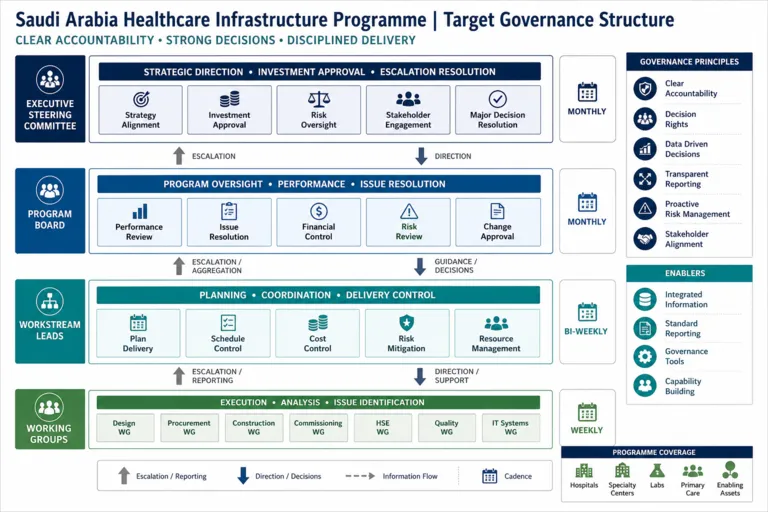
- PMO Design & Governance Framework: Designed the PMO operating model, governance structure, decision rights, and meeting and escalation cadence, establishing clear accountability between the organisation, contractors, and consultants across the asset portfolio.
- Integrated Controls Implementation: Implemented standardised cost, schedule, risk, change, and document-control processes across all assets, creating a consistent control environment and comparable data that enabled programme-level oversight.
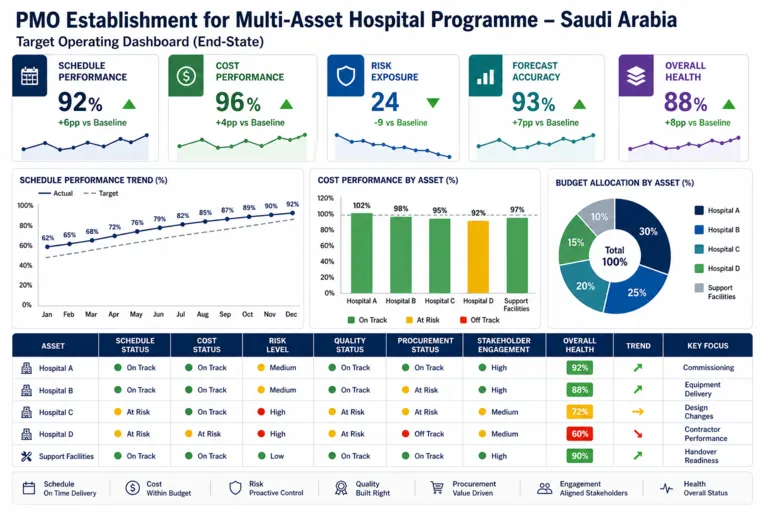
- Reporting & Decision-Support Systems: Established integrated programme reporting and dashboards providing leadership with a single, reliable view of status, cost, forecast, and risk, together with forecasting and early-warning indicators to support proactive decision-making.
- Risk & Interface Management: Stood up a proactive risk-management function and a structured interface-management process coordinating dependencies across design, construction, medical equipment procurement, and commissioning to reduce clashes, rework, and delay.
- Capability Transfer: Embedded PMO processes, tools, and capabilities within the organisation's team and trained internal staff to sustain the function, ensuring the control environment endured beyond the engagement.
Recommendations
- Single Source of Programme Truth: Recommended consolidating all asset reporting into a single programme management information system with standardised data definitions, giving leadership one authoritative view and ending reliance on inconsistent partner-supplied reports.
- Stage-Gated Governance: Recommended introducing stage-gated governance with defined approval criteria at each project phase, preventing assets from progressing with unresolved design, cost, or readiness issues that would surface as overruns later.
- Proactive Risk Escalation: Recommended a tiered risk-escalation protocol with clear thresholds and ownership, ensuring emerging cost and schedule risks reached decision-makers early enough for effective mitigation rather than after impact.
- Commissioning & Clinical Readiness Integration: Recommended integrating medical equipment procurement and clinical commissioning into the programme schedule from the outset, recognising that operational readiness, not just construction completion, determined the date each hospital could open.
Engagement ROI
- Restored Schedule Control: Within the first six months, the PMO's integrated controls and early-warning reporting enabled corrective intervention on the most delayed assets, recovering an estimated four months of slippage against the programme critical path.
- Cost Overrun Avoidance: Standardised cost and change control surfaced emerging overruns early, enabling mitigation that avoided an estimated SAR 180 million in forecast cost growth across the portfolio.
- Improved Decision Speed: Integrated reporting and escalation reduced the time leadership needed to identify and act on programme issues, materially improving decision speed and the quality of resource-allocation decisions.
- Reduced Rework: Structured interface management reduced design and construction clashes between assets and disciplines, lowering rework and the associated cost and schedule impact.
- Sustainable Internal Capability: Capability transfer left the organisation with an embedded, internally staffed PMO able to govern the remainder of the programme and future capital projects, delivering value well beyond the engagement period.
Talk to us for your needs in:
-
Economic & Social Impact Assessment
-
Environmental Impact Assessment & ESG
-
Market Entry Strategy
-
Business Model Transformation
-
Project Management Office (PMO)
-
Site Selection Advisory
-
Risk Assessment
-
Operational Excellence
-
Supply Chain Analysis
-
Feasibility Study
-
Growth Strategy
-
Mergers & Acquisitions (M&A)