

Client
A Saudi municipal transport authority responsible for planning, developing, and operating public transport services across a major Saudi Arabian city experiencing rapid population growth driven by Vision 2030's economic development agenda. Facing escalating traffic congestion, declining public transport modal share, and a mandate to deliver significant improvements in urban mobility performance, the authority engaged Saudi Strategy Advisory to develop a comprehensive smart mobility strategy and public transport transformation roadmap aligned with Vision 2030's urban quality of life and sustainability commitments.
Issues
The transport authority faced a complex and interrelated set of strategic, operational, and investment challenges:
- Declining Public Transport Adoption: Public transport modal share had declined to below 8% of total urban trips, significantly below the authority's Vision 2030 targets. Increasing private vehicle ownership, driven by rising household incomes, combined with inadequate public transport service quality, limited the system's ability to attract discretionary riders.
- Network Coverage & Connectivity Gaps: The existing public transport network suffered from significant geographic coverage gaps, poor intermodal connectivity between bus, metro, and emerging ride-sharing services, and inadequate first- and last-mile solutions. These limitations created journey time and convenience barriers that discouraged public transport usage even among residents with access to available services.
- Operational Performance Deficiencies: Bus network on-time performance averaged below 65%, vehicle reliability rates were insufficient, real-time passenger information systems were absent, and customer service quality consistently generated low satisfaction ratings. These shortcomings undermined confidence in public transport as a practical alternative to private vehicle use.
- Digital Integration Absence: The authority lacked integrated digital ticketing, real-time journey planning tools, open-data APIs supporting third-party mobility application development, and the data analytics infrastructure needed to optimize network performance based on actual demand patterns. This limited both service improvement capabilities and the authority's contribution to Saudi Arabia's smart city development agenda.
- Governance & Funding Sustainability: The authority's governance model, performance management frameworks, and funding structures were not designed to support the scale of investment and operational transformation required. Fragmented accountability across multiple government entities created coordination inefficiencies and delayed critical investment decisions.
- Saudization Workforce Transition: A significant reliance on expatriate operational staff created both Saudization compliance risk and workforce transformation challenges as the authority sought to develop the local talent pipeline required for long-term operational sustainability.
Solution
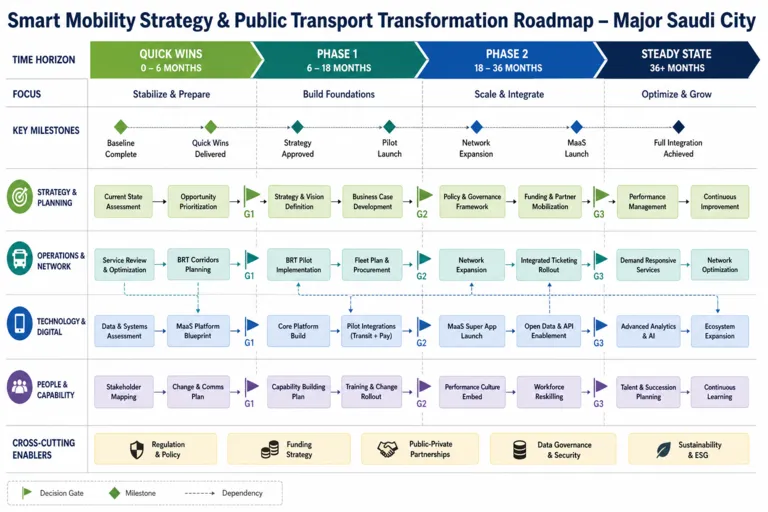
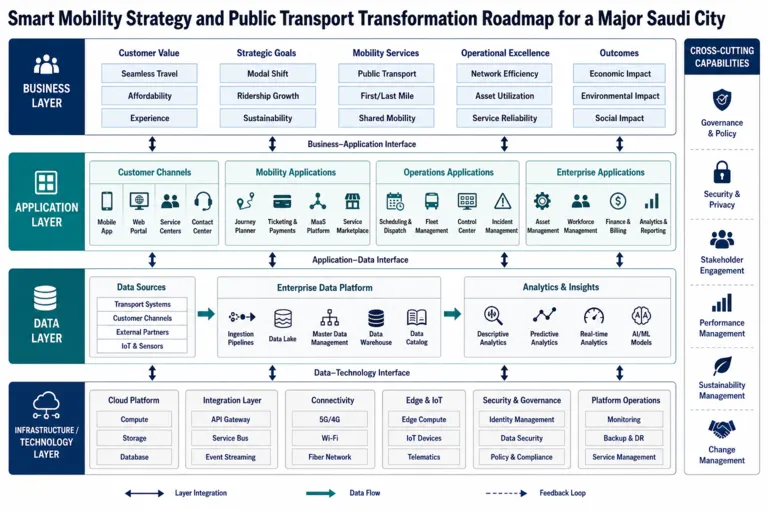
Saudi Strategy Advisory was engaged to deliver a comprehensive Smart Mobility Strategy and Public Transport Transformation Roadmap — providing the authority with an integrated strategic, operational, technological, and governance transformation blueprint aligned with Vision 2030's urban mobility, quality of life, and sustainability objectives.
Approach
The engagement was structured across five integrated workstreams:
- Mobility Demand Analysis & Network Assessment: Conducted comprehensive origin-destination demand analysis using mobile network data, household travel surveys, and traffic count data. Mapped current and projected mobility demand patterns across the city's geography against existing network coverage and capacity to identify the specific service gaps and network deficiencies most significantly affecting public transport adoption.
- Smart Mobility Strategy Design: Developed an integrated smart mobility strategy framework covering network design optimization, intermodal integration architecture, digital platform development, Mobility-as-a-Service (MaaS) ecosystem design, autonomous vehicle readiness planning, and micro-mobility integration. The strategy was aligned with Saudi Arabia's smart city agenda and the authority's Vision 2030 modal share objectives.
- Operational Transformation Program: Designed a comprehensive operational improvement program addressing bus scheduling and route optimization, fleet reliability enhancement, real-time passenger information implementation, customer service improvement, and performance management framework development. The program targeted measurable improvements in the operational performance indicators most strongly linked to increased public transport adoption.
- Digital Infrastructure & Technology Roadmap: Developed a phased digital investment roadmap covering integrated ticketing modernization, real-time journey planning platforms, open-data API frameworks, passenger analytics capabilities, and smart traffic signal priority systems. Investments were sequenced to maximize customer experience improvements while maintaining capital efficiency.
- Governance & Funding Restructuring: Designed a restructured governance framework that clarified accountability between the authority and relevant government stakeholders, established a performance-based funding model linked to modal share and service quality outcomes, and developed a long-term financial sustainability plan incorporating fare optimization, commercial revenue generation, and infrastructure financing mechanisms.
Recommendations
Key strategic recommendations delivered through the engagement:
- Priority Corridor Investment: Recommended immediate investment in four high-frequency Bus Rapid Transit (BRT) corridors connecting the city's highest-density origin-destination pairs. The proposed corridors were designed to serve 65% of total public transport demand while representing only 12% of total network route kilometers, maximizing passenger impact per unit of capital invested and creating a high-quality service backbone capable of transforming public perception of public transport.
- MaaS Platform Development: Recommended the development of a city-wide Mobility-as-a-Service (MaaS) platform integrating public transport, ride-sharing, micro-mobility, and parking services through a single digital interface. The platform was positioned as the city's primary mobility management tool, aligned with Saudi Arabia's digital economy objectives, and projected to increase public transport trip planning by approximately 45%.
- First & Last Mile Strategy: Recommended a structured first- and last-mile mobility ecosystem combining electric micro-mobility hubs at major transport interchanges, demand-responsive feeder services in lower-density areas, and integrated park-and-ride facilities. The strategy directly addressed connectivity gaps identified as the primary barrier to public transport adoption among key commuter segments.
- Performance-Based Governance: Recommended transitioning to a performance-based operating contract model for bus network services, linking operator compensation to modal share growth, on-time performance, and customer satisfaction outcomes. This approach shifted a greater share of performance risk to operators while creating strong incentives for continuous service quality improvement.
- Saudization Workforce Program: Recommended a structured 48-month Saudization acceleration program focused on bus operations, customer service, and transport planning functions. The program incorporated partnerships with Saudi technical and vocational training institutions alongside competitive career development pathways designed to attract and retain Saudi nationals within the public transport sector.
Engagement ROI
The Smart Mobility Strategy and Transformation Roadmap delivered significant strategic and operational value:
- Modal Share Trajectory: Implementation of the priority BRT corridors generated a 3.2 percentage point increase in public transport modal share within 18 months of service launch. This represented the largest modal share improvement in the city's transport history and placed the authority on track to achieve its Vision 2030 modal share objectives.
- Operational Performance Improvement: The operational improvement program increased bus on-time performance from 63% to 84% within 12 months, resulting in measurable improvements in customer satisfaction and a significant reduction in passenger complaint volumes.
- Capital Investment Optimization: Network prioritization analysis enabled the authority to focus available capital on the four BRT corridors responsible for 65% of total demand impact. This reduced required capital expenditure by SAR 2.1 billion compared to the original network expansion plan while delivering stronger modal share outcomes.
- Digital Platform Value: Development of the MaaS platform attracted partnerships with three private sector mobility operators, contributing SAR 85 million in private capital toward platform development. This reduced public-sector digital infrastructure investment requirements while accelerating implementation timelines.
- Governance Funding: Performance-based governance restructuring secured an additional SAR 320 million in annual transport funding through alignment with Vision 2030 quality-of-life program funding mechanisms, addressing the authority's most significant long-term financial sustainability challenge.
Talk to us for your needs in:
-
Economic & Social Impact Assessment
-
Environmental Impact Assessment & ESG
-
Market Entry Strategy
-
Business Model Transformation
-
Project Management Office (PMO)
-
Site Selection Advisory
-
Risk Assessment
-
Operational Excellence
-
Supply Chain Analysis
-
Feasibility Study
-
Growth Strategy
-
Mergers & Acquisitions (M&A)