

Client
A national Saudi retail group operating a large network of stores and a growing e-commerce channel across multiple consumer categories, supported by a complex import-led supply chain and a network of distribution centres. Facing service disruptions, high inventory costs, and exposure to global supply volatility, the group engaged Saudi Strategy Advisory to analyse its end-to-end supply chain and design a resilience and efficiency strategy.
Issues
- Import Dependency & Supply Volatility: The group's heavy reliance on imported goods exposed it to global freight volatility, lead-time variability, and geopolitical disruption, periodically causing stock-outs and lost sales that the group could not consistently prevent.
- High Inventory, Low Availability: The group simultaneously carried high inventory and experienced frequent availability gaps, indicating poorly aligned inventory and replenishment policies that tied up working capital without delivering service.
- Distribution Network Inefficiency: The distribution-centre network and transport flows had grown organically and were not optimised for the group's current store and e-commerce footprint, creating excess cost and slow replenishment to certain regions.
- Omnichannel Fulfilment Strain: Rapid e-commerce growth was straining a supply chain designed for store replenishment, with no clear fulfilment model for online orders, undermining both cost efficiency and the customer experience.
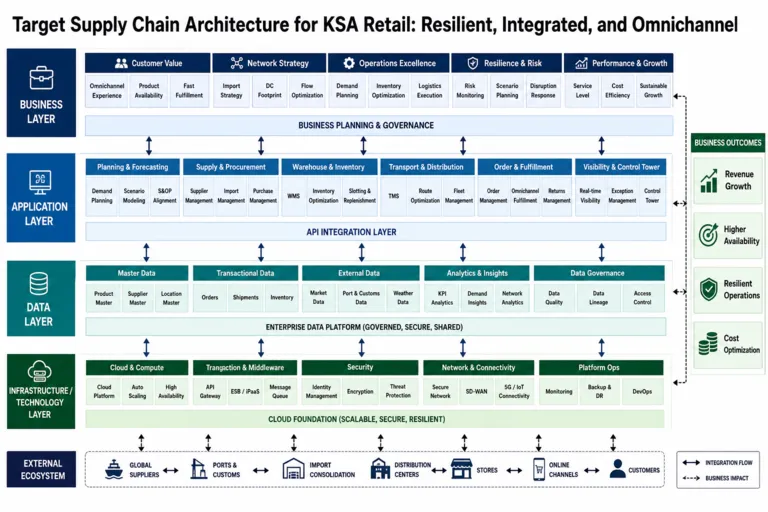
- Limited Supply Chain Visibility: Fragmented systems and data prevented end-to-end visibility of inventory, orders, and supplier performance, limiting the group's ability to plan, respond to disruption, and manage suppliers effectively.
Solution
Saudi Strategy Advisory was engaged to deliver an end-to-end Supply Chain Analysis and Resilience Strategy — providing the group with a diagnostic of its supply chain performance and vulnerabilities, optimised inventory and network design, an omnichannel fulfilment model, and a resilience strategy to reduce cost, improve availability, and withstand disruption.
Approach
- End-to-End Supply Chain Diagnostic: Mapped and analysed the group's supply chain from sourcing through distribution to store and online fulfilment, quantifying cost, service, inventory, and lead-time performance and identifying the principal inefficiencies and vulnerabilities.
- Inventory & Replenishment Optimisation: Analysed demand patterns and segmented products by volume and variability to design differentiated inventory and replenishment policies that reduced working capital while improving on-shelf and online availability.
- Distribution Network Modelling: Modelled the distribution-centre network and transport flows against the current and projected store and e-commerce footprint, identifying the optimal network configuration to minimise total logistics cost and improve replenishment speed.
- Fulfilment Design: Designed an omnichannel fulfilment model defining how online orders would be sourced and delivered across distribution centres and stores, balancing cost efficiency with delivery speed and customer experience.
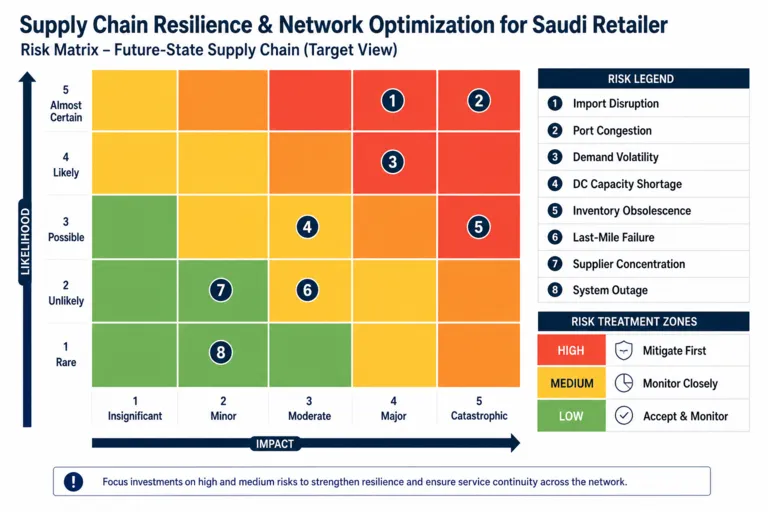
- Resilience & Sourcing Strategy: Assessed supply concentration and disruption risk and developed a resilience strategy combining supplier diversification, strategic safety stock for critical lines, near-shoring and local sourcing where viable, and improved end-to-end visibility.
Recommendations
- Segmented Inventory Policy: Recommended differentiated inventory and replenishment policies by product segment, holding leaner stock on stable high-volume lines and targeted safety stock on critical and volatile lines, simultaneously releasing working capital and improving availability.
- Network Reconfiguration: Recommended reconfiguring the distribution network around a smaller number of optimally located distribution centres with regional cross-dock points, reducing total logistics cost and improving replenishment speed to underserved regions.
- Distributed Omnichannel Fulfilment: Recommended a distributed fulfilment model using stores as forward fulfilment points for online orders in dense urban areas, lowering last-mile cost and delivery times while leveraging existing inventory.
- Supplier Diversification & Local Sourcing: Recommended diversifying critical-category suppliers and increasing local and regional sourcing where commercially viable, reducing exposure to global freight volatility and aligning with localisation objectives.
Engagement ROI
- Working Capital Release: Segmented inventory policies were projected to reduce inventory holdings by approximately SAR 220 million while improving availability, releasing working capital and lowering carrying costs.
- Logistics Cost Reduction: Network reconfiguration and transport optimisation were projected to reduce total distribution cost by an estimated 12%, improving the group's cost position in a competitive retail market.
- Availability Improvement: Improved replenishment and inventory policies materially reduced stock-out frequency on key lines, recovering lost sales and improving the in-store and online customer experience.
- Lower-Cost Omnichannel Fulfilment: The distributed fulfilment model reduced e-commerce last-mile cost and delivery times in major cities, improving online profitability and supporting continued channel growth.
- Greater Resilience: Supplier diversification, targeted safety stock, and improved visibility strengthened the group's ability to anticipate and absorb supply disruption, reducing the frequency and impact of availability shocks.
Talk to us for your needs in:
-
Economic & Social Impact Assessment
-
Environmental Impact Assessment & ESG
-
Market Entry Strategy
-
Business Model Transformation
-
Project Management Office (PMO)
-
Site Selection Advisory
-
Risk Assessment
-
Operational Excellence
-
Supply Chain Analysis
-
Feasibility Study
-
Growth Strategy
-
Mergers & Acquisitions (M&A)