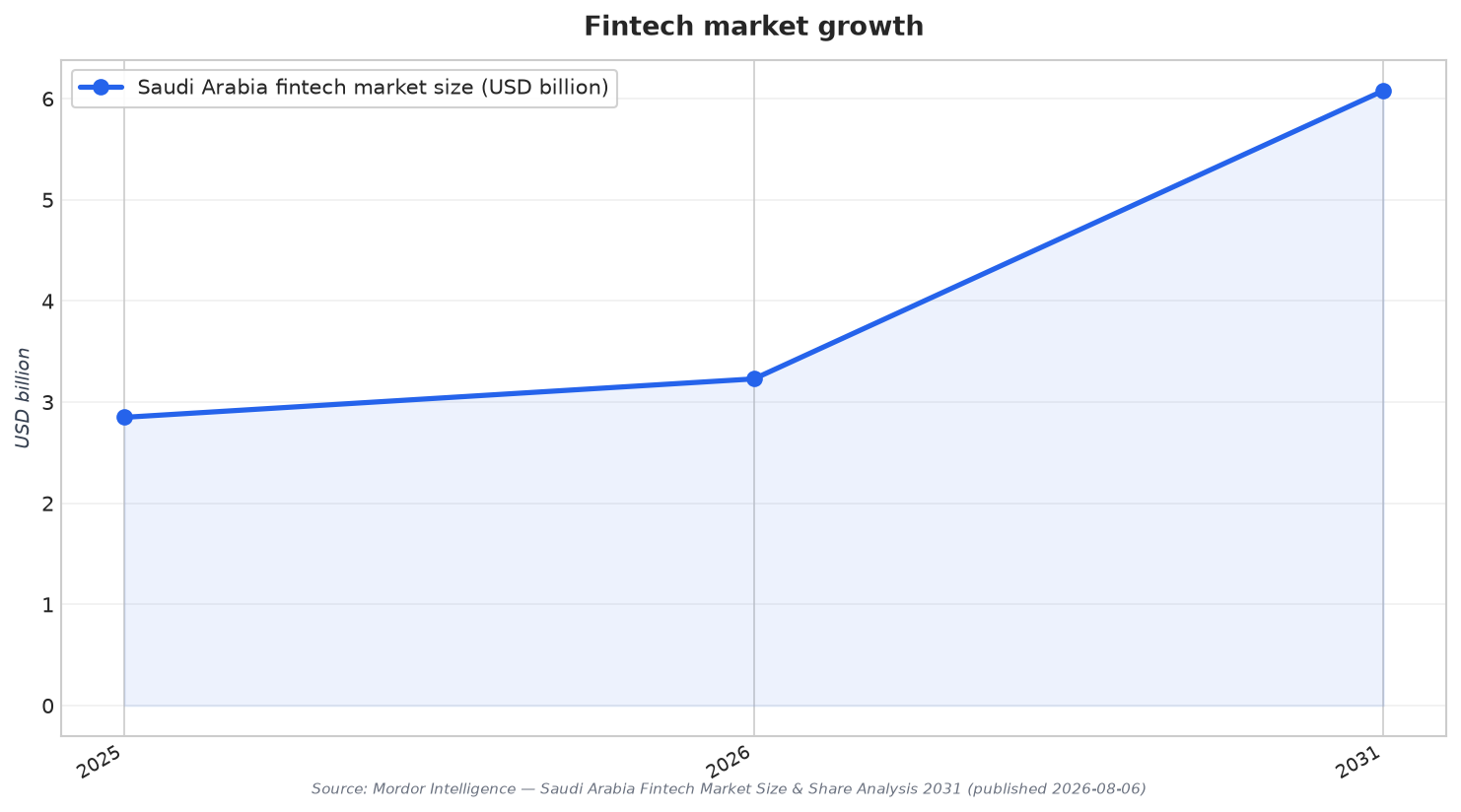
Saudi Arabia’s financial services landscape is being reshaped by policy-led modernization tied to Vision 2030 programs. The country’s fintech market was valued at USD 2.85 billion in 2025, and Mordor Intelligence estimates growth from USD 3.23 billion in 2026 to USD 6.08 billion by 2031, a 13.45% CAGR. The same source links momentum to open banking APIs, embedded finance models, and consent-based data access that move customer journeys beyond traditional bank channels into retail and digital ecosystems. By mid-2025, the ecosystem crossed 261 licensed firms, created 11,046 direct jobs, and reached SAR 7.9 billion (USD 2.1 billion) in cumulative funding, setting a stronger baseline for competitive pressure on incumbents.
Payments are a visible wedge in this transition. Electronic payments accounted for 79% of all retail transactions in 2024, and near-field communication payment adoption reached 94%, which Mordor Intelligence says positioned the Kingdom at the top of global rankings on that metric. Within fintech service propositions, digital payments led with a 48.62% market share in 2025, while mobile applications represented a 67.59% share by user interface in 2025. In retail banking, online banking already accounted for 58.77% of market share in 2025, with Mordor Intelligence projecting online banking to post the highest channel growth at a 14.74% CAGR through 2031. For incumbents, this makes product design, loyalty economics, and “time-to-integrate” as important as branch density.
Open Banking and Licensing: What Changed and Why It Matters
In 2026, open banking moved from experimentation to a more durable operating model. Saudi Market Research Consulting reports that on 26 March 2026, the Saudi Central Bank (SAMA) moved open banking out of a controlled testing environment and into a formal licensing regime, after completion of the sandbox phase where selected firms trialled use cases under SAMA supervision. The same source frames the shift as a maturity milestone aligned with Vision 2030 and the National Fintech Strategy, supported by standardized APIs that enable secure, customer-consented data sharing. As global context, it notes a 2026 roundup in developed markets where 81% of banks say open banking is “critical to survival,” alongside estimates of API call volumes at over 6.7 billion per month; these figures are not Saudi performance, but they illustrate why API readiness is treated as strategic capacity.
Fintech licensing is also compressing competitive timelines. MarkWide Research describes SAMA’s regulatory sandbox as governing licensing, capital requirements, and consumer protection standards, with graduated tiers that let firms test products with limited customer bases before full deployment. It adds that license approvals can compress traditional bank partnership timelines from years to months, pushing incumbents toward alliances or acquisitions of licensed neobanks. The Vision 2030 fintech strategy page reinforces that SAMA has licensed several fintech lending platforms using alternative data sources, while SIMAH expanded data coverage and analytics capabilities to support more granular credit information. Taken together, the Saudi financial services transformation is increasingly about integrating compliance, data governance, and product iteration speed into a single operating model, not treating them as separate workstreams.
For incumbents, strategy should start from where balance sheets and customer relationships are already strongest, then extend through APIs and partnerships. Mordor Intelligence values the Saudi retail banking market at USD 53.22 billion in 2026 and forecasts USD 82.94 billion by 2031 at a 9.28% CAGR, while noting consumer loan balances at SAR 476 billion (USD 126.84 billion) in Q3 FY2025 and real-estate loans to individuals at SAR 726.2 billion (USD 193.50 billion). National banks held 81.89% of retail banking market share in 2025, but neobanks and others are projected to grow at an 18.29% CAGR through 2031. Practical options include building API-first capabilities to distribute mortgage and card propositions in third-party journeys, partnering with licensed fintechs in payments and SME credit, or selectively acquiring regulated players where integration unlocks faster reach than internal buildouts.
What is driving Saudi Arabia’s financial services shift toward fintech and APIs?
When did open banking move into a formal licensing regime in Saudi Arabia?
What do the payments numbers say about digital adoption in the Kingdom?
How should incumbents respond to the Saudi financial services transformation?
Talk to us for your needs in:
-
Economic & Social Impact Assessment
-
Environmental Impact Assessment & ESG
-
Market Entry Strategy
-
Business Model Transformation
-
Project Management Office (PMO)
-
Site Selection Advisory
-
Risk Assessment
-
Operational Excellence
-
Supply Chain Analysis
-
Feasibility Study
-
Growth Strategy
-
Mergers & Acquisitions (M&A)