Saudi Arabia’s Vision 2030 rollout put giga-projects at the center of economic diversification, foreign investment attraction, and visitor growth. Nearly nine years after the inaugural announcements, the delivery environment has shifted toward “shifting, delaying or re-scoping major projects,” as Saudi officials describe it. External conditions also show up in procurement and contracting volume: the value of GCC construction contracts, particularly across Saudi Arabia, fell nearly 40% year-on-year to USD 67 billion in the first five months of 2025, from USD 110 billion in 2024. Against that backdrop, recovery work becomes less about defending an original plan and more about re-baselining to what can be executed credibly.
Any giga-project recovery PMO in Saudi Arabia has to start with portfolio reality. Sources describe a pullback in spending by the Public Investment Fund (PIF), with reduced spending reflecting mounting fiscal risks and “some cuts reaching as high as 60%.” By May 2026, an internal audit cited by The Wall Street Journal pegged full NEOM completion at USD 8.8 trillion, while another report describes The Line’s budget estimate moving from USD 1.6 trillion in late 2021 to USD 4.5 trillion by the following spring. The recovery point is clear: if scope is not executable at announced cost and timeline, the baseline must change, and the PMO must make that change governable.
A PMO Framework to Re-Baseline Scope, Cost, and Schedule
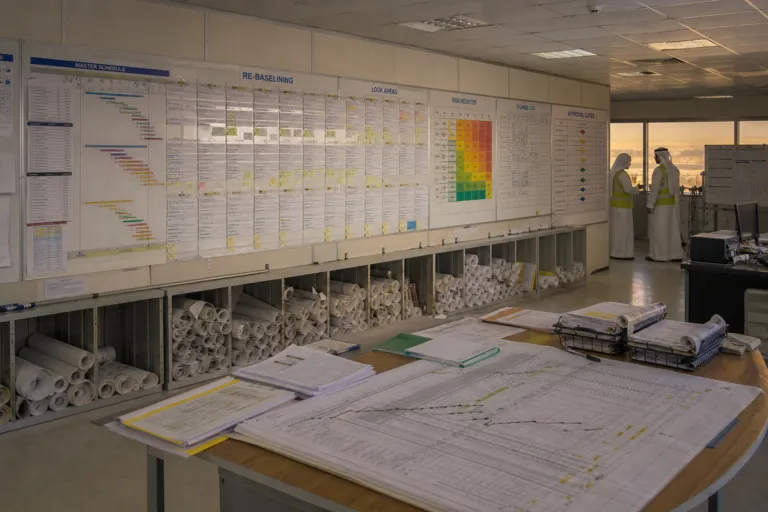
Step one is a controlled scope reset with formal reviews and decision rights. For example, NEOM’s chief executive initiated a comprehensive review of scope and priorities, and The Line was placed under strategic review. Outcomes then need to be translated into a measurable baseline: The Line has been described as scaled back to a projected 2.4 km by 2030, while another source notes visible output of about 2.4 kilometres of foundation and a closed luxury island alongside a half-built ski resort. A recovery PMO should turn these outcomes into a governed “minimum viable” delivery definition, with traceable links between product scope, benefits intent, and what procurement packages will actually deliver.
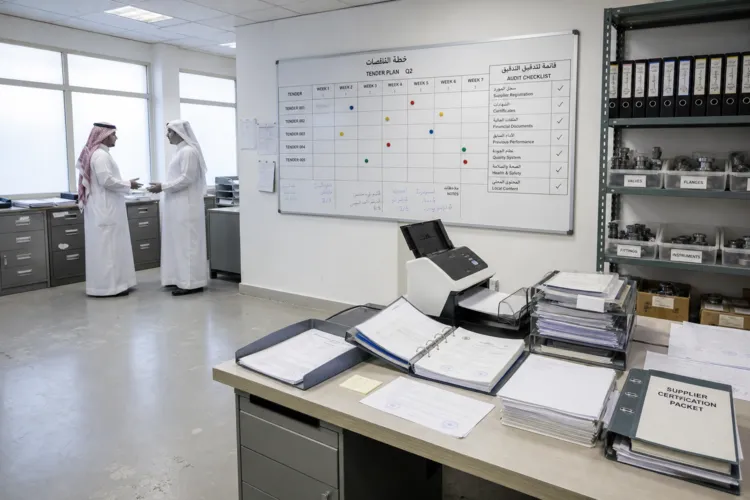
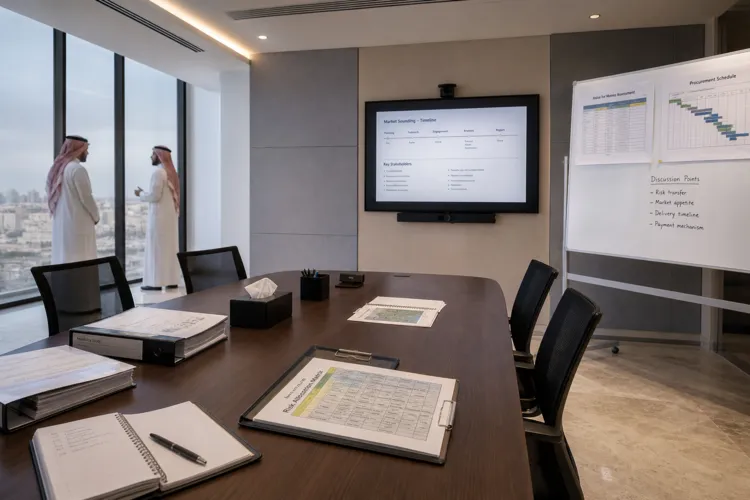
Step two is cost and schedule re-baselining through packaging discipline and procurement controls. Saudi giga-projects commonly operate via dedicated PIF-owned development companies with professional procurement and contract administration teams, and they often retain international programme management consultants such as Bechtel, AECOM, Mace, Jacobs, and WSP. Contract packaging ranges from mega-packages exceeding USD 1 billion, to mid-range USD 50 million to USD 1 billion, to smaller packages below USD 50 million. A recovery PMO can use that structure to sequence what must be awarded now versus deferred, while ensuring prequalification remains tight, including financial assessment norms such as turnover typically at least three times the annual contract value.
Step three is assurance and transparency built for complex capital portfolios. One article notes that organisations should move beyond traditional PMOs and establish high-impact PMOs designed for control and assurance, while also warning that research estimates 75% of PMOs fail within three years. In Saudi Arabia, a case study focused on ZATCA found a statistically significant relationship between project characteristics and PMO effectiveness in relation to reasons for project failure. For the giga-project context, the practical lesson is to hard-wire recovery governance: clear baselines, independent challenge of assumptions, and regular re-forecasting that matches the Kingdom’s stated preference for transparency when plans shift, delay, or re-scope.
Why are Saudi giga-projects being re-scoped and re-baselined?
What numbers show the scale of the current reset in delivery expectations?
How can a PMO re-baseline scope, cost, and schedule on a giga-project?
What procurement structures matter most for recovery planning in Saudi giga-projects?
What is a practical way to position a giga-project recovery PMO in Saudi Arabia without overpromising?
Talk to us for your needs in:
-
Economic & Social Impact Assessment
-
Environmental Impact Assessment & ESG
-
Market Entry Strategy
-
Business Model Transformation
-
Project Management Office (PMO)
-
Site Selection Advisory
-
Risk Assessment
-
Operational Excellence
-
Supply Chain Analysis
-
Feasibility Study
-
Growth Strategy
-
Mergers & Acquisitions (M&A)