Building a local content strategy Saudi Arabia teams can execute starts with a simple reality: local content is a scored, audited, and enforced criterion that can affect whether a company wins government contracts or is shut out of procurement. Saudi Arabia uses two distinct frameworks that push in the same direction. The Local Content and Government Procurement Authority (LCGPA) is the national body that sets methodology, issues Local Content Certificates, integrates local content into government procurement evaluation, and conducts audits. In parallel, Saudi Aramco runs IKTVA (In-Kingdom Total Value Add) as its proprietary supplier program. They share a philosophy but operate independently, with different measurement methodologies, reporting platforms, and compliance timelines.
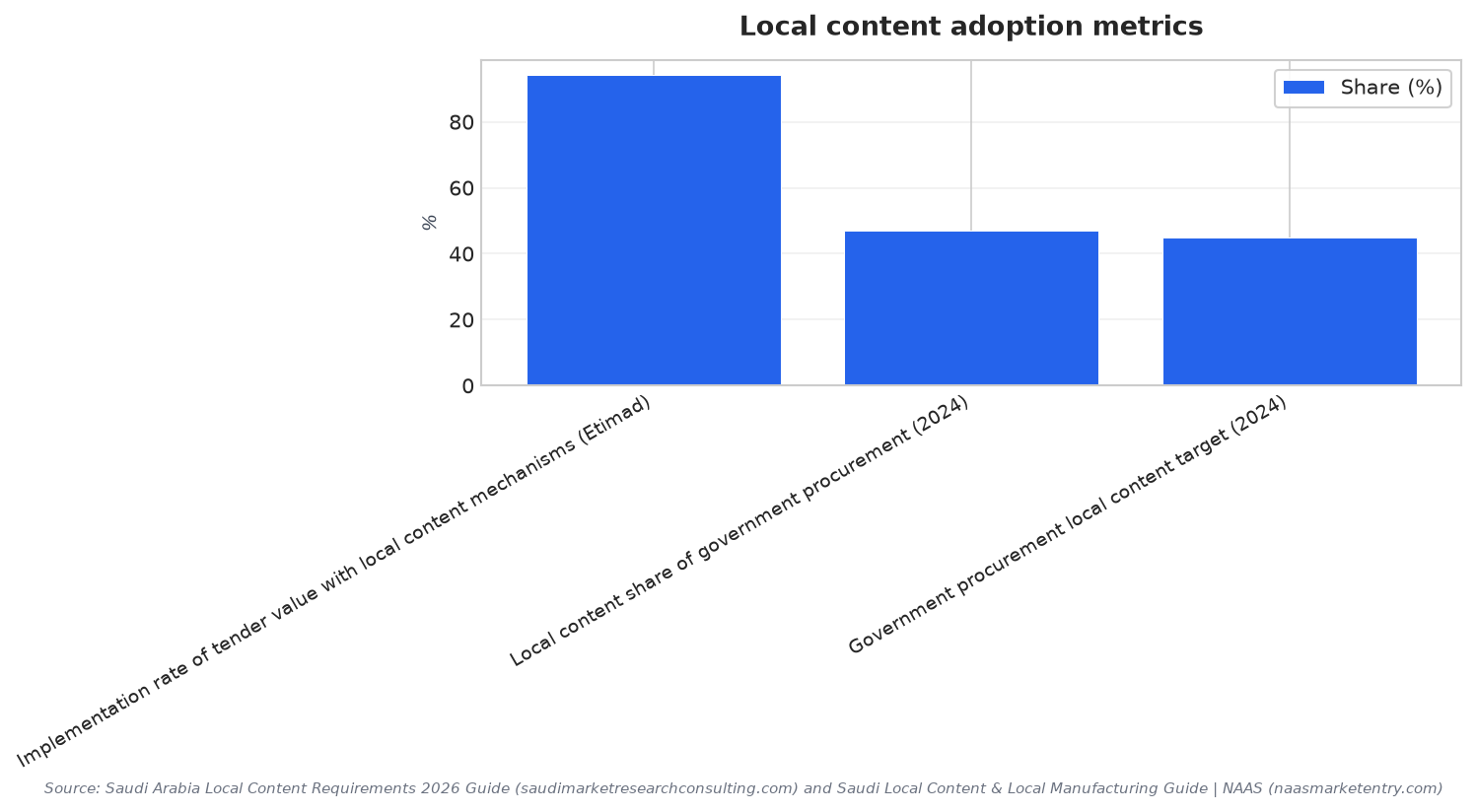
For government work, the numbers show how embedded the mechanism has become. According to LCGPA, the value of tenders incorporating local content mechanisms on Etimad reached SR316.4 billion, representing an implementation rate of 94.1% of total tender value. In addition, local content reached about 47% of government procurement in 2024, against a 45% target. These signals matter in bid planning because local content is not just a narrative add-on. It is treated as a primary commercial KPI and, in government procurement, it is a weighted scoring element. Guidance also notes that LCGPA introduced a 30% minimum local content requirement for certain government management consulting and IT services tenders, applied in phases beginning with management consulting and expanding to IT services.
LCGPA Requirements: Baselines, Certification, and Tender Levers
LCGPA turns local content into a measurable percentage using a standardized methodology that accounts for domestic goods, local services, Saudi workforce salaries, and investments in local assets. One practitioner guide describes four weighted components, including goods and services spend with Saudi-registered suppliers, Saudi workforce compensation, and assets and capital items such as depreciation of locally manufactured assets and locally built facilities. Baseline work depends on documentation. One government-contract guide warns that calculating the baseline score requires meticulous financial documentation and that LCGPA requires figures to be audited and certified by an independent, licensed auditing firm before they can be officially submitted in government bids. Companies then engage an LCGPA-approved auditor to verify the figures and issue the Local Content Certificate, which multiple sources describe as an increasingly common tender requirement and a decisive factor in evaluations.
IKTVA requires a parallel plan because it is Aramco’s own program with its own reporting template. A manufacturing-focused guide describes IKTVA as a supplier score based on in-Kingdom spending on goods and services, Saudi salaries, training, supplier development, and research, divided by revenue from Aramco, and verified each year by a certified third party. Even when you are bidding outside Aramco, the operational lesson carries over: your suppliers’ local content can flow into yours, making supplier selection a scoring decision. Several sources emphasize practical levers such as shifting procurement from international suppliers to locally registered vendors and prioritizing subcontractors or suppliers with higher LCGPA certification scores because their contribution can flow into your overall project score. The same guide cautions that targets become contractual commitments, so over-promising may win a bid but can create penalties and margin loss during delivery.
Supplier development is not only a commercial tactic; it also fits within how Saudi Arabia evaluates localization. LCGPA’s remit includes supervising supplier-development obligations attached to large contracts and developing mandatory and preferential lists for product categories that must be sourced locally. Beyond procurement, localization is tied to manufacturing origin rules. Under Saudi Arabia’s 2021 rules of origin, a product qualifies as Saudi-origin with at least 40% local value added and a workforce that is at least 25% national, with some flexibility between the two; qualifying products move duty-free across the GCC and the Greater Arab Free Trade Area, and on preferential terms to the GCC’s free-trade partners. In practice, a credible plan links certified measurement, supplier onboarding, and capability building so your tender claims match auditable performance.
How do you build a local content strategy for Saudi Arabia tenders?
What is the difference between LCGPA and IKTVA?
What tender data shows local content is widely used on Etimad?
Are there minimum local content thresholds in some service tenders?
What is required to submit an official LCGPA baseline score in bids?
Talk to us for your needs in:
-
Economic & Social Impact Assessment
-
Environmental Impact Assessment & ESG
-
Market Entry Strategy
-
Business Model Transformation
-
Project Management Office (PMO)
-
Site Selection Advisory
-
Risk Assessment
-
Operational Excellence
-
Supply Chain Analysis
-
Feasibility Study
-
Growth Strategy
-
Mergers & Acquisitions (M&A)