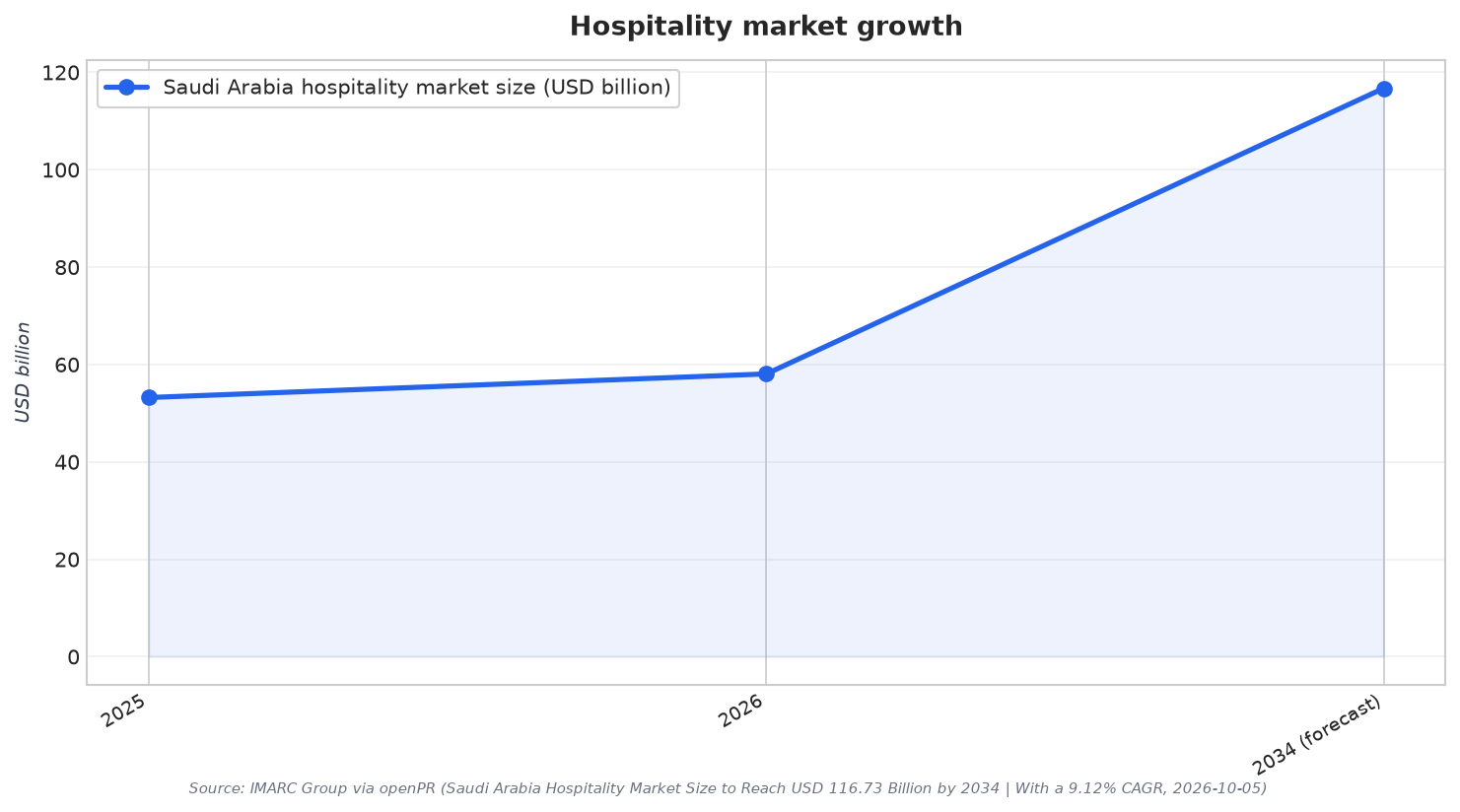
Looking past construction milestones is now the core discipline for Saudi Arabia’s tourism capital cycle. Multiple market trackers point to a fast-expanding base that is not only about one destination at a time. IMARC reports Saudi Arabia’s hospitality market at USD 53.22 Billion in 2025 and USD 58.07 Billion in 2026, with a projection of USD 116.73 Billion by 2034 at a 9.12% CAGR for 2026–2034. Mordor Intelligence, using its own framework, estimates USD 27.14 billion in 2025 and USD 29.02 billion in 2026, reaching USD 40.58 billion by 2031 at 6.93% CAGR. For underwriting, the key takeaway is direction and structure: growth, and a widening footprint across multiple cities and corridors.
That structure is visible in the mix. Chain hotels lead, with IMARC placing chain properties at 52.4% share in 2025, while Mordor estimates 57.74% share in 2025 and forecasts independents trailing as chain operators expand at an 11.62% CAGR through 2031. Demand anchors still matter for de-risking: IMARC cites 18.5 million pilgrims visiting Makkah and Madinah in 2024 and occupancy exceeding 85% during Hajj and Umrah seasons, alongside 115.9 million total tourist trips in 2024. The distribution reality also shapes cash flow strategy: both IMARC and Mordor cite OTAs capturing 41.65% of bookings or transactions in 2025, while Mordor notes direct digital channels growing at 14.78% CAGR as hotels invest in proprietary platforms.
Red Sea, Diriyah, and AlUla: Investable Signals Beyond Hype
The Red Sea story is most useful when translated into deliverability and product type. Vision2030.ai’s project tracking describes Red Sea Phase 1 as operational, with 25–30 hotels by 2027, and notes that there is no audited public total cost, only independent estimates ranging from USD 13 billion (Phase One hospitality) to USD 23 billion (full infrastructure inclusive of airport and Phase Two land works). On the demand side, Mordor expects the Red Sea and wider western coast to expand at an 18.20% CAGR to 2031, and it already frames the western story through the Makkah–Jeddah corridor holding 26.62% share in 2025. For investors, this supports a thesis of clustered luxury supply with measurable regional momentum rather than one-off openings.
Diriyah and AlUla read as complementary plays: heritage and place-making that can feed boutique and specialty formats. IMARC’s luxury hotel segmentation explicitly links boutique, heritage, and wellness specialty properties (6.9%) to expansion through AlUla and Diriyah development. It also points to resorts as the fastest-growing type at a 28.6% share and about 13.2% CAGR through 2034, while suite hotels hold 18.3% and airport hotels 11.4%. Project tracking adds delivery realism: Diriyah Gate Phase 1 was promised for 2026, and AlUla expansion is listed as including Sharaan and Hegra. A notable operational signal is the late-2025 appointment of John Pagano as managing director of AlUla destination management, which vision2030.ai describes as extending Red Sea Global’s operational reach and signaling intent to apply its playbook beyond the Red Sea coast.
Execution risk and pacing are now part of the narrative, and that can be constructive for a Saudi hospitality investment strategy built on commercial discipline rather than timelines alone. Nomad Lawyer reports that, as of May 7, 2026, there are 100,000 hotel rooms under construction, and it ties investor confidence to a 2025 milestone of 100 million visitors. The same source frames a balancing act between foundational pilgrimage demand and high-yield luxury segments in AlUla and the Red Sea coastline, arguing the shift is toward “commercial discipline.” Investors can translate that into practical moves: prioritize chain partnerships where chains already dominate share, underwrite distribution with OTAs at 41.65% but rising direct channels, and match format to destination positioning, from resort growth to specialty heritage-led properties.
What does a Saudi hospitality investment strategy need beyond giga-project headlines?
What verified indicators show the Red Sea is moving from concept to capacity?
Which segments are most directly linked to AlUla and Diriyah in the sources?
How important are digital channels and OTAs for hotel investment planning?
What do the sources say about the scale of Saudi Arabia’s hospitality market growth?
Talk to us for your needs in:
-
Economic & Social Impact Assessment
-
Environmental Impact Assessment & ESG
-
Market Entry Strategy
-
Business Model Transformation
-
Project Management Office (PMO)
-
Site Selection Advisory
-
Risk Assessment
-
Operational Excellence
-
Supply Chain Analysis
-
Feasibility Study
-
Growth Strategy
-
Mergers & Acquisitions (M&A)