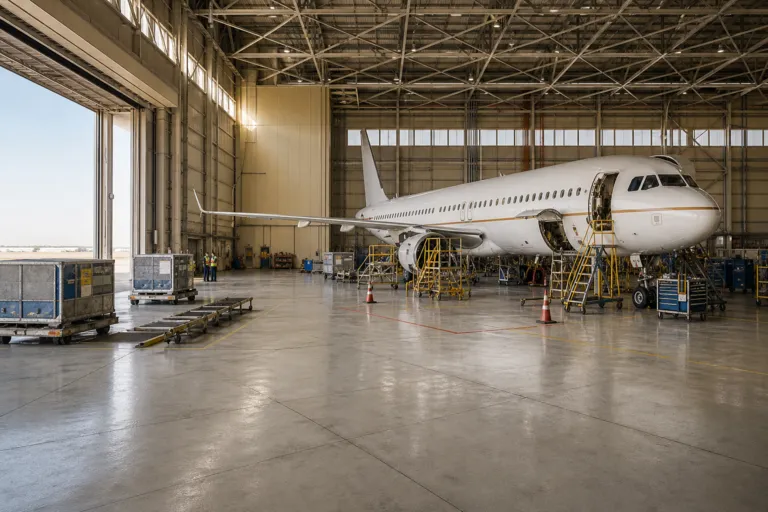
Saudi Arabia’s aviation expansion sits inside Vision 2030 and is framed as a system-wide push across airports, airlines, cargo, investment, and services. The Saudi Aviation Strategy is described as being backed by approximately $100 billion in government and private-sector investment, aimed at transforming the Kingdom into an international aviation and logistics hub. Multiple national sources align on top-line goals for 2030: 330 million annual passengers, links to more than 250 destinations, and 4.5 million tonnes of annual air-cargo capacity. In one framing, this is more than triple a pre-pandemic level of approximately 100 million passengers, which implies execution pressure across construction, operations, regulation, and demand generation.
Airport development is central, but the targets must be read as goals rather than proof of immediate operational capacity. A practical operator guide notes that the General Authority of Civil Aviation (GACA) describes national goals of 330 million passenger capacity and 250+ destinations by 2030, while reminding operators to confirm the current status of each airport, permits, slots, and handling. For Riyadh, the King Salman International Airport master plan includes a passenger-capacity goal of 100 million by 2030. Another Vision 2030 programme analysis describes King Salman International Airport as a new greenfield airport designed to accommodate 120 million passengers annually at full buildout, with full build-out extending into the 2030s in phased development planning.
Privatisation and New Carriers: Where the Commercial Models Shift
Privatisation is explicitly part of the transport-and-logistics reform toolkit. Under the National Transport and Logistics Strategy, airport operations have been progressively opened to private operators through concessions and PPP frameworks. That matters because the growth agenda is not only about pouring concrete; it is also about ramping operational efficiency, customer service, and predictable regulation. On the airline side, Riyadh Air was announced in 2023 as a new PIF-backed carrier headquartered in Riyadh and positioned to operate from King Salman International Airport. It targets over 100 destinations by 2030. In parallel, Saudia is described as undergoing fleet expansion and route network growth, and in 2025 it announced more than 10 new international destinations, including Vienna, Venice, Athens, Bali, and Nice, following a 16% increase in passenger transport (as reported in the cited analysis).
Business aviation is also being pulled into the liberalisation story, creating demand for handling, permits, and premium airport services. A private-aviation advisory source reports that business jet movements surged 24% in 2024 to over 23,600 flights, with domestic private jet flights rising 26% year-on-year. It also cites regulatory changes such as cabotage removal on May 1, 2025, allowing foreign-registered aircraft to conduct domestic flights without local partners, plus permission for one-way flights that reduce empty return legs. These changes can increase competition and traffic, and they sharpen the case for specialist services including slots coordination, ground handling, fuel arrangements, security, and passenger processing for high-frequency charter activity.
Across the value chain, the opportunity set extends beyond terminals. The investment programme is described as covering airport expansion, new airlines, aircraft fleets, cargo infrastructure, logistics facilities, aviation services, and digital systems. That translates into near-term demand in air-traffic systems, ground infrastructure, digital check-in, biometrics, baggage handling, and cybersecurity, alongside hospitality and commercial real estate enabled by new connectivity. Maintenance is another investable layer: one sector brief projects the Saudi MRO market reaching SAR 9 billion ($2.4 billion) annually by 2030, supported by fleet growth and regional demand. For investors and operators, Saudi aviation strategy 2030 is therefore less a single project than a stack of linked bets: assets, operations, and service ecosystems moving together.
What are the 2030 passenger, destination, and cargo targets for Saudi Arabia’s aviation plan?
How does airport privatisation show up in Saudi Arabia’s transport reforms?
What role does Riyadh Air play in the national aviation push?
What signals growing activity in Saudi private aviation?
What opportunities across the value chain are linked to the Saudi Aviation Strategy 2030?
Talk to us for your needs in:
-
Economic & Social Impact Assessment
-
Environmental Impact Assessment & ESG
-
Market Entry Strategy
-
Business Model Transformation
-
Project Management Office (PMO)
-
Site Selection Advisory
-
Risk Assessment
-
Operational Excellence
-
Supply Chain Analysis
-
Feasibility Study
-
Growth Strategy
-
Mergers & Acquisitions (M&A)