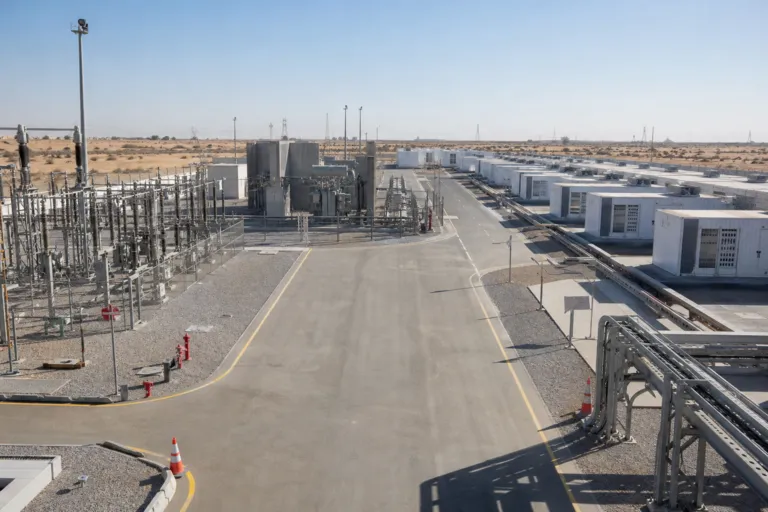
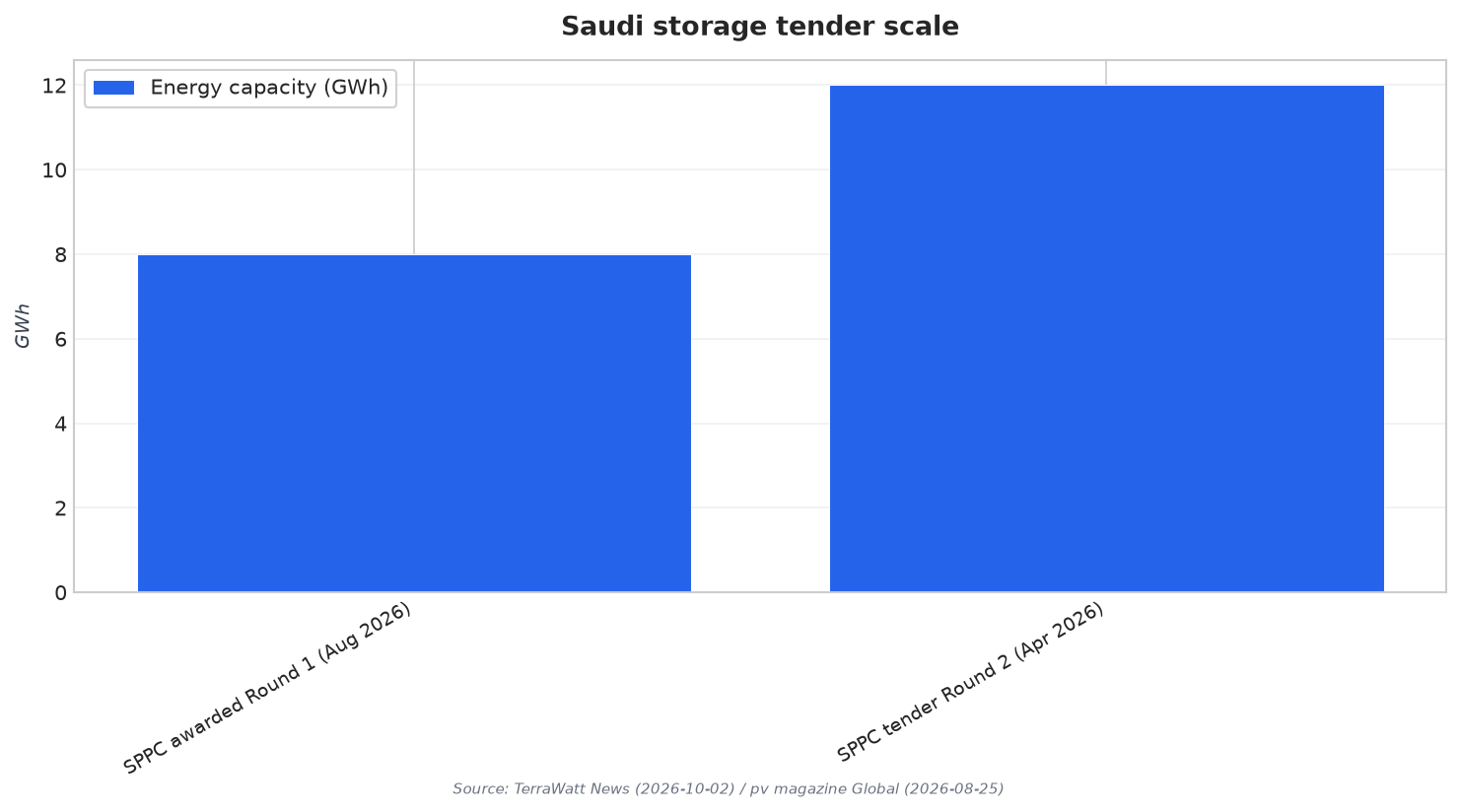
Saudi Arabia’s first government-tendered, build-own-operate battery awards have turned a long-anticipated market into an observable one. On 20 August 2026, the Saudi Power Procurement Company (SPPC) announced four battery energy storage projects totalling 2 GW/8 GWh, signed at a ceremony in Riyadh attended by Energy Minister Prince Abdulaziz bin Salman bin Abdulaziz, who is also SPPC’s board chairman. Multiple sources describe the portfolio’s investment value as more than SAR 4.35 billion, around US$1.16 billion. For grid and power investors, the immediate takeaway is less about headline size and more about what has now been standardized: project sizing, duration, ownership, and the long-term contract that bankability can be built around.
The awards show what Saudi battery energy storage looks like at utility scale under SPPC’s procurement model. The initial program was launched in November 2024 as a qualification round for four projects, each at 500 MW/2,000 MWh with four hours of discharge, and it drew a prequalified group of 33 companies. Under the tender structure reported by pv magazine Global, the winning consortiums hold 100% equity in special purpose vehicles responsible for developing and operating the assets. Each project is backed by a 15-year Storage Services Agreement (SSA) with SPPC acting as Principal Buyer, with projects supervised by the Ministry of Energy. That combination of BOO ownership and a long-duration service contract is the commercial “shape” investors can now underwrite.
What the Awards Reveal About Risk, Returns, and Who Gets Paid
The winners and disclosed roles highlight how risk is being distributed across developers, contractors, and technology providers. Terrwatt.news reports that Saudi Energy, ACWA Power, and contractor Al Sharif took three of the four projects—Haden and Al-Muwayh in Makkah province and Al-Kahfah in Hail—while Engie, partnered with Saudi services group Haji Abdullah Alireza, won Al-Khushaybi in Qassim, with Engie putting the investment at around US$220 million. Energy-Storage.News also notes that three agreements were signed with the consortium including Saudi Energy, ACWA Power, and Al Sharif. Separately, Energy-Storage.News’ roundup cites that the Al Muwayah, Haden, and Al Kahafa sites are each configured at 500 MW/2 GWh, and that Gotion valued roughly 75% of the 2 GW/8 GWh tender at approximately US$1.16 billion—underscoring how suppliers may frame value even when procurement details vary by contract package.
For investors looking beyond round one, the pipeline is being defined in public, with a second tender already in motion. SPPC has prequalified 27 consortia for a second round comprising six Independent Storage Provider projects totalling 3 GW/12 GWh, with each project rated at 500 MW/2,000 MWh and four hours of discharge. The qualification round launched in late April 2026, closed on 5 May, and the shortlist was announced on 30 June 2026. In parallel, an IMARC Group summary carried by openPR positions storage as part of a broader battery market outlook, stating Saudi Arabia’s battery market size reached USD 1,401.8 million in 2025 and is projected to reach USD 2,910.3 million by 2034, with a CAGR of 8.46% during 2026–2034. The same source also states that Saudi Arabia is targeting 130 GW of renewable capacity and 48 GWh of battery storage, and that about 18 GWh of grid-connected storage has already been energized, including a 7.8 GWh portfolio across three sites—Najran, Khamis Mushait, and Madaya—each rated at 2.6 GWh.
The strategic signal from the 2 GW/8 GWh awards is that Saudi procurement is moving from “one-off projects” to repeatable contracting. With SPPC acting as Principal Buyer and using 15-year SSAs, bidders in later rounds can price against a known structure rather than assumptions. The participation mix—Saudi developers and service groups alongside international utilities and developers on the second-round shortlist, and technical members such as system suppliers—suggests a market where ownership and equipment roles may separate cleanly. For grid stakeholders, the consistent four-hour configuration across both rounds indicates a focus on a specific operational use case; for capital providers, the combination of BOO SPVs and long-term service agreements provides the kind of template that accelerates deployment once a first clearing price is visible.
What exactly did SPPC award in the first storage round?
How are the projects contracted and owned under the SPPC model?
Which companies won the four awarded projects and where are they located?
What is happening in the second SPPC storage tender?
What does the SPPC award imply for Saudi battery energy storage investors?
Talk to us for your needs in:
-
Economic & Social Impact Assessment
-
Environmental Impact Assessment & ESG
-
Market Entry Strategy
-
Business Model Transformation
-
Project Management Office (PMO)
-
Site Selection Advisory
-
Risk Assessment
-
Operational Excellence
-
Supply Chain Analysis
-
Feasibility Study
-
Growth Strategy
-
Mergers & Acquisitions (M&A)