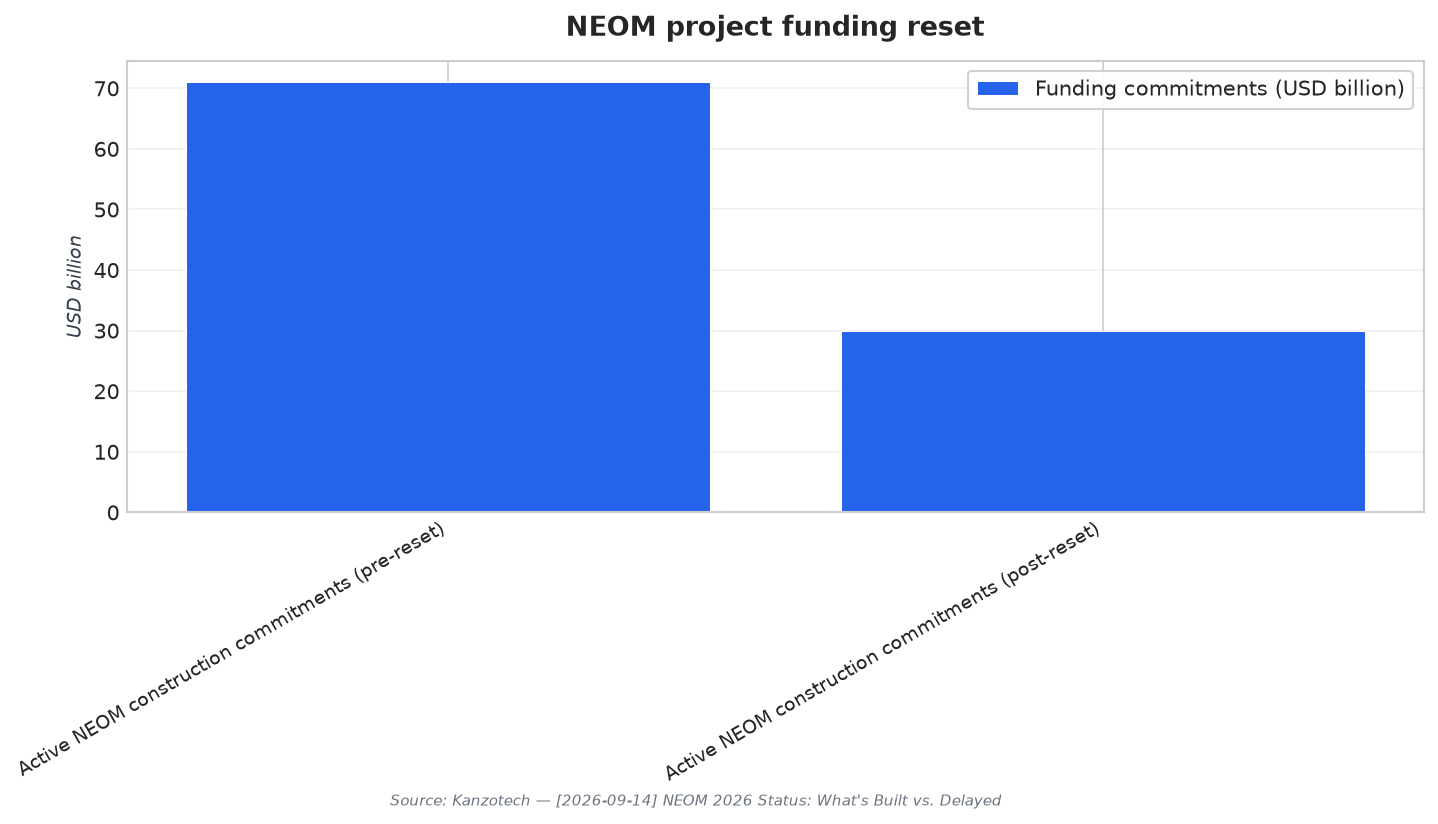
After a broad reprioritization of NEOM, the green hydrogen plant remains one of the few assets described with straightforward project-finance logic. The facility is budgeted at USD 8.4 billion, was reported at 80% complete, and is tracked toward commissioning in Q3 2026. It reached financial close on 22 May 2023, using USD 6.1 billion in non-recourse project financing from 23 banks and institutions, including participation from the Saudi Industrial Development Fund and the National Infrastructure Fund. The joint venture structure is an equal partnership among ACWA Power, Air Products, and NEOM, which is wholly owned by PIF. Separately, PIF reportedly cut its active NEOM construction commitments from around USD 71 billion to about USD 30 billion, a 60% reduction, highlighting why a de-risked cash-flow model matters.
The export proposition is built around derivatives and logistics that already exist in global trade. The plant converts hydrogen into green ammonia for export, with Air Products holding exclusive offtake rights under a 30-year agreement. Once running, the facility is designed to produce 600 tonnes of carbon-free hydrogen daily, which is converted to green ammonia, with an estimated 5 million tonnes of CO2 savings per year. On the supply side, the site is designed around up to four gigawatts of dedicated renewable generation, including 5.6 million solar panels producing up to 2.2 GW of solar energy and over 250 wind turbines generating 1.6 GW of wind energy, spread across more than 300 square kilometres. This design supports the NEOM green hydrogen strategy as an export-scale industrial system rather than a pilot.
Offtake Risk Is the Divider Between Bankable and Announced
Across the wider market, the signal is consistent: projects move from announcement to construction when demand risk is transferred to creditworthy buyers through binding contracts. EnkiAI noted that firm offtake agreements cover less than 5% of potential production capacity announced for 2030, which frames a large demand gap. In parallel, approximately 50 hydrogen projects have been publicly canceled, as cited via ING analysis, as higher costs and slower-than-expected demand growth exposed speculative pipelines. The NEOM model is repeatedly described as a benchmark because its bankability is tied to a long-term take-or-pay style offtake for its full output through Air Products, rather than depending on shifting policy signals. This is also why non-recourse lenders could rely on project cash flows rather than sponsor guarantees.
Export economics are also shaped by the reality of cost competitiveness, especially for buyers deciding whether to switch from incumbent hydrogen. In Europe, green hydrogen was cited at USD 4.50 to USD 6.00 per kg versus USD 1.50 to USD 2.50 per kg for grey hydrogen, creating a gap that can stall discretionary demand without contract structures. In this environment, the NEOM project’s reliance on green ammonia as a carrier and commodity is material, because green ammonia demand is repeatedly described as an anchor for giga-scale projects and as a practical pathway for shipping fuel and fertilizer-linked value chains. Air Products’ exclusive offtake and references to European industrial customers under decade-long agreements position NEOM’s output toward contracted industrial channels rather than spot exposure.
Industrial demand scenarios, therefore, hinge on how much consumption is “built in” to real value chains. Green ammonia is described as both a fertilizer feedstock and a hydrogen carrier, and the global pipeline is increasingly tied to industrial integrations that can sign bankable contracts. The Middle East is presented as a regional leader in execution, with Saudi Arabia’s NEOM project cited at over 2 GW in the context of construction readiness. Equipment and build-out details reinforce the industrial scale: the NEOM project includes a 1 GW electrolyzer shipment from Thyssenkrupp, and the EPC contract value is cited at USD 6.7 billion awarded to Air Products. In a reset environment where residential and tourism-linked timelines carry risk, this kind of contract-led industrial demand is the scenario in which NEOM’s hydrogen export thesis stays durable.
What is the financing structure behind NEOM’s green hydrogen plant?
How does the project reduce offtake risk for exports?
What scale and output is the plant designed to reach once operational?
How has policy and market uncertainty affected green hydrogen projects globally?
How does the NEOM green hydrogen strategy fit after the broader PIF reset?
Talk to us for your needs in:
-
Economic & Social Impact Assessment
-
Environmental Impact Assessment & ESG
-
Market Entry Strategy
-
Business Model Transformation
-
Project Management Office (PMO)
-
Site Selection Advisory
-
Risk Assessment
-
Operational Excellence
-
Supply Chain Analysis
-
Feasibility Study
-
Growth Strategy
-
Mergers & Acquisitions (M&A)