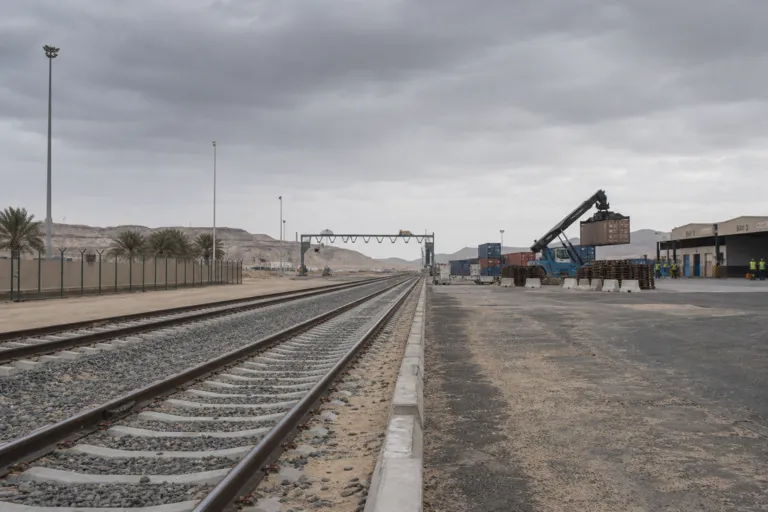
Saudi Arabia’s Landbridge is planned as an east-west freight rail corridor linking Arabian Gulf ports with Red Sea gateways through Riyadh. Vision 2030 framing emphasizes lower logistics friction and stronger port-rail integration, built on the Kingdom’s geography of roughly 1,200 kilometres between coasts. The corridor is described as connecting King Abdulaziz Port at Dammam and the adjacent Jubail industrial port to western gateways including Jeddah Islamic Port and the planned King Abdullah Port at KAEC. Multiple alignments have been studied, with estimated length commonly cited at about 1,000 to 1,300 kilometres depending on final routing, and other updates describing a corridor spanning more than 1,500 kilometres including a 900 km Riyadh–Jeddah line.
For freight corridors, the operating logic is time and predictability. One cited benefit is a cut in Red Sea-to-Gulf transit by 72 hours, while another description says the corridor could compress Red Sea-to-Gulf transfers to under 48 hours. The broader land-bridge integration narrative links the corridor to wider GCC connectivity, describing Saudi Arabia’s 1,018 km of operational rail and an expansion context through the USD 100 billion Gulf Railway. In that regional framing, the corridor is positioned as a bypass to chokepoints and congestion, with one claim that it can trim transit times on Mumbai–Europe lanes by up to eight days. For shippers, the commercial implication is a viable rail option when ocean routings face disruption.
Delivery Model: Port-Rail-Road Intermodal, Dry Ports, and Hubs
The delivery model is intermodal by design, built around reload points that connect ship, rail, and road. Landbridge-focused commentary highlights inland dry ports designed for double-stack containers, where carriers that can provide drayage at both railheads can capture higher-margin intermodal moves. Inland capacity already exists at meaningful scale: Riyadh Dry Port is cited as processing 950,000 TEUs annually, with on-site bonded storage that can reduce gateway dwell time. The same planning framework cites 59 inland logistics centers covering 100 million m², structured to attract private investment through 30-year concessions. Another update describes nearly 20 modern logistics hubs along the corridor, including seven logistics centers stretching from Yanbu to Riyadh.
Investment and throughput expectations vary by source, but they shape shipper planning and contracting strategies. One market brief cites the domestic Landbridge as an approximately 1,300-kilometre project backed by an estimated USD 7 billion investment. Another update also states total investment stands at USD 7 billion, adding that construction began in 2025 with operations targeted for the late 2020s and an expectation of over 50 million tons of freight per year once operational. A separate logistics zone article, citing Nexdigm, describes the Landbridge as spanning 1,300 km and expected to carry up to 3 million TEUs annually upon completion, while also stating the current rail freight network already handles 12.8 million tons per year. These figures matter because they indicate potential capacity availability, but shippers should align commitments to the assumptions behind each estimate.
Strategically, the corridor lands in a market where road remains dominant and multimodal diversification is accelerating. One estimate puts road freight at around 95% of total freight volume, moving across a national road network spanning roughly 316,900 kilometres, so rail adoption changes routing decisions rather than replacing trucking. The Landbridge’s shipper value proposition is resilience plus network optionality: rail can reduce exposure to Red Sea risks and support more predictable inland distribution toward the main logistics triangle described as Riyadh, the Eastern Province, and the Jeddah–Makkah corridor. In parallel, policy and operating conditions are shifting, including mandatory telematics on commercial vehicles from January 2025, which affects drayage execution and compliance. Together, these dynamics encourage shippers to design contracts that cover rail line-haul, road first/last mile, and bonded storage as one service outcome.
What does the Saudi Landbridge rail project connect?
How much time could the Landbridge save on Red Sea-to-Gulf movements?
What investment levels are cited for the Landbridge?
What capacity and throughput figures are mentioned for rail and inland nodes?
How should shippers think about the delivery model around the corridor?
Talk to us for your needs in:
-
Economic & Social Impact Assessment
-
Environmental Impact Assessment & ESG
-
Market Entry Strategy
-
Business Model Transformation
-
Project Management Office (PMO)
-
Site Selection Advisory
-
Risk Assessment
-
Operational Excellence
-
Supply Chain Analysis
-
Feasibility Study
-
Growth Strategy
-
Mergers & Acquisitions (M&A)